North Carolina Opens State Roads to License-Plate Readers. What Does That Mean for Camden County?
North Carolina now permits automated license-plate readers along state-maintained roads. Camden County has not announced a deployment. Here is what the law allows, what safeguards exist, and what residents can ask before any local decision is made.

This audio narration was generated by Camden Tribune using the open-source Kokoro speech model.
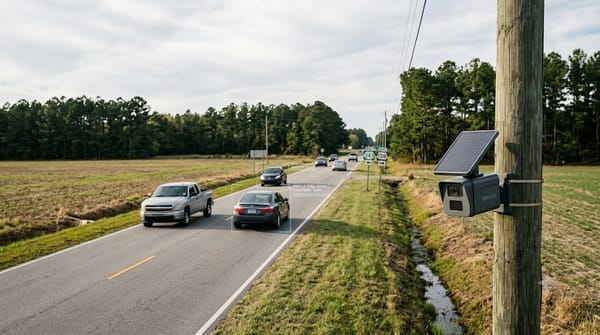
CAMDEN, N.C. — North Carolina law-enforcement agencies now have a permanent path to place automated license-plate readers along state-maintained roads, including major highways and rural routes.
The authority appears in Section 43.26 of the state budget enacted as Session Law 2026-41. The license-plate-reader language appears on pages 604 and 605 of the 634-page budget law.
For Camden County, the law means the Sheriff’s Office could seek approval to install automated readers on eligible state-maintained roads. It does not mean Camden County has already approved, purchased, or installed the cameras.
The Camden County Sheriff’s Office does not appear on the State Bureau of Investigation’s list of 32 agencies that participated in the earlier highway pilot. As of publication, Camden Tribune has not identified a public announcement, contract, or deployment notice showing that Camden County has joined the permanent program.
The central local question is not whether Camden County already has these highway cameras. The question is whether the Sheriff’s Office intends to seek them—and what safeguards would apply if it does.
What the new state law does
Section 43.26 creates a new statute allowing the North Carolina Department of Transportation to enter agreements with the SBI for automatic license-plate-reader systems on NCDOT land and rights-of-way.
The SBI may enter an agreement for its own use or act as the administrative agent for a federal, state, or local law-enforcement agency. The equipment must be above ground, removable and operated in accordance with North Carolina’s existing license-plate-reader laws.
The law also requires the SBI to submit an annual report to a legislative oversight committee. For each participating agency, the report must include:
- The agency’s written policy governing the system.
- The number of requests for captured data, organized by requesting agency.
- The number of cameras in the agency’s system.
The statute does not require Camden County to participate. It does not name Flock Safety, select a particular vendor or establish a statewide camera limit. It also does not require a local public hearing before a camera is installed.
The budget authorizes expansion, but it does not name a Flock appropriation
The new law clearly makes the highway program permanent. However, Section 43.26 does not contain a stated appropriation to buy a particular number of cameras, and it does not award a contract to Flock Safety.
In its April 7, 2026 pilot report, the SBI separately requested funding for one statewide coordinator, $225,000 in recurring funding for access to several vendors’ databases and possible grants to help local agencies purchase and install readers. The SBI said the proposed grant focus would be major highways and interstates, to cover entrances and exits to North Carolina.
Those were SBI requests and recommendations. They should not be described as proof that the budget purchased Flock cameras for Camden County.
What the cameras record
North Carolina law defines an automatic license-plate-reader system as one or more fixed or mobile high-speed cameras used with computer algorithms to convert license-plate images into computer-readable data.
Depending on the system, a record may include:
- The plate number.
- The date and time of the observation.
- The camera location.
- The vehicle’s direction of travel.
- A photograph of the plate and vehicle.
- Vehicle characteristics such as make, model, body type, or color.
Agencies can compare those records with databases involving stolen vehicles, stolen plates, wanted people, missing or endangered people, and vehicles connected to criminal investigations. A possible match can generate an alert for law enforcement.
An alert is not the same as proof. It is a lead that officers should verify before taking enforcement action.
The North Carolina pilot was already large
The SBI reported that 32 agencies joined the pilot. As of March 15, 2026, 17 agencies had installed cameras at 140 state-right-of-way locations, with another 75 locations awaiting approval or installation.
The agency totals in the report add up to 152,708,436 license-plate captures.
Raleigh Police operated three pilot cameras. Those three readers recorded 14,828,580 plates and generated 956 National Crime Information Center alerts between July 2025 and January 2026. Of those alerts, 227 involved stolen vehicles.
The report did not provide a complete outcome for each Raleigh alert. It did not show, for example, how many resulted in confirmed vehicle recoveries, arrests, missing-person recoveries or false matches. That distinction matters because the number of alerts measures possible database matches—not final investigative results.
Supporters point to public-safety successes
The SBI report describes cases in which license-plate-reader data helped identify vehicles connected to shootings, homicide investigations, robberies, stolen vehicles, drug trafficking and missing people.
The report also describes a case in which the data helped support a woman’s alibi by showing that she was in another county shortly before a homicide. In that situation, the technology helped investigators exclude a person rather than identify her as a suspect.
Those examples show why many law-enforcement leaders support the technology. A reader placed on a well-traveled route can generate a lead quickly when officers are looking for a stolen vehicle, an endangered person or a suspect believed to be traveling through the area.
North Carolina legislative leaders made a similar public-safety argument when discussing the permanent program. In WRAL’s reporting on the new law, supporters emphasized that vehicles traveling on public roads can already be observed and photographed.
North Carolina has statewide rules—but many details remain local
Claims that North Carolina has no rules governing license-plate readers are not completely accurate.
Under Article 3D of Chapter 20, an agency must adopt a written policy before operating a system. The policy must address data retention, data sharing, operator training, supervisory oversight, internal security, auditing and access to systems operated by other agencies.
State law also provides that:
- Data may be obtained, accessed, preserved or disclosed only for law-enforcement purposes.
- The data may not be used for traffic-violation enforcement.
- Captured plate data generally may not be preserved for more than 90 days.
- Longer preservation requires a qualifying sworn preservation request or search warrant.
- Captured plate data is confidential and is not a public record.
- The data may not be sold.
- Unlawful access or disclosure is a Class 1 misdemeanor.
These rules are important. They also leave major operational choices to each agency.
State law does not expressly require a warrant before every historical search. It does not require supervisor approval before every query. It does not mandate an independent outside audit, publication of general camera locations, public reporting of false alerts, or a local sunset date requiring the program to be renewed.
The permanent annual report is also narrower than the pilot report in several respects. The new statute expressly requires camera counts, data-request totals and written policies. It does not expressly require annual disclosure of the total number of vehicles scanned, false alerts, misuse investigations or case outcomes.
Why errors and verification procedures matter
License-plate recognition is not infallible. A camera may misread a character, a database may contain stale information, or a record may be entered incorrectly.
In July, automotive journalist Joel Feder described being surrounded by police after cameras and a faulty stolen-plate entry connected his test vehicle to the wrong record. According to Feder’s first-person report in The Drive, the system did not properly account for smaller characters on a New Jersey manufacturer plate. Police had tracked the vehicle for days before stopping him and his wife.
That incident did not occur in Camden County, and it is not evidence of misconduct by Camden deputies. It illustrates why a local policy should clearly require officers to confirm the plate, vehicle description, hot-list status and other available facts before escalating a stop whenever circumstances allow.
Misuse by individual officers has also been documented
Technical errors are not the only concern. License-plate databases contain information that can be attractive to an employee seeking to monitor someone for a personal reason.
In Georgia, a former police chief was charged with using automated plate-reader systems to stalk and harass people. The allegations were reported by the Associated Press. The case remains subject to the legal process.
Again, this is not an allegation against the Camden County Sheriff’s Office. It demonstrates why strong controls matter even when an agency trusts its personnel.
Useful safeguards can include individual user accounts, required case numbers, written search justifications, automatic audit logs, regular supervisory review, alerts for unusual search activity, and meaningful discipline for personal use.
Flock is a company, not the name of the entire technology
Public discussions often use “Flock cameras” as a general term for automated plate readers. Flock Safety is one vendor in a larger market.
The North Carolina law is vendor-neutral. The SBI pilot allowed participating agencies to select their own vendors, and the SBI reported that pilot agencies were working with four companies.
This distinction matters because replacing one company does not necessarily end license-plate surveillance. An agency can move to another provider while continuing to collect and search similar vehicle data.
Flock’s broader product line has raised separate questions
Flock’s standard license-plate reader should not be confused with the company’s Condor pan-tilt-zoom video camera.
An InvestigateTV report demonstrated a Condor camera using artificial intelligence to follow a reporter walking along a public trail. The report also described Flock training materials that discussed following vehicles and suspects across multiple locations.
The Condor is a different product from a standard license-plate reader. The distinction should be made clear rather than treating every Flock device as identical.
At the same time, local officials should determine whether a proposed contract is limited to plate recognition or provides access to a broader platform that includes live video, pedestrian detection, cross-agency searches, drones or other capabilities.
What online reaction shows—and what it does not
Online comments supplied to the Camden Tribune were heavily skeptical of the technology. Commenters repeatedly raised concerns about government surveillance, private companies storing data, artificial intelligence, data centers and the use of “public safety” to justify expanded monitoring.
“Always the same excuse, for your safety,” one commenter wrote. Another said, “We have enough surveillance.” A smaller number responded that people who do not break the law should not be concerned.
Those comments are not a scientific survey. The Camden Tribune has not verified the commenters’ identities or established that they live in Camden County. They should not be presented as a measure of local public opinion.
They do show the questions officials are likely to face if cameras are proposed without a public explanation.
Some online commenters encouraged people to damage or cut down cameras. Camden Tribune does not endorse vandalism, destruction of property or interference with law-enforcement equipment. Residents who oppose surveillance technology have lawful methods available, including public meetings, records requests, communication with elected officials and legal challenges when appropriate.
What has Camden County decided?
As of publication, the Camden Tribune has not confirmed that Sheriff J. Kevin Jones has requested, purchased or installed highway license-plate readers under the new law.
The Sheriff’s Office website identifies transparency, accountability, innovation and protection of constitutional rights as parts of the agency’s mission. Those principles provide a reasonable framework for a public discussion if the technology is considered.
The Sheriff’s Office and Board of Commissioners have different responsibilities. Operational questions about law-enforcement policy belong primarily with the Sheriff’s Office. Questions involving county appropriations, recurring subscription costs, or county-funded contracts may also involve the commissioners. The exact approval process can depend on the proposed funding source and agreement.
Neither the sheriff nor the commissioners should be described as supporting or opposing the technology until they state their positions or take official action.
Questions Camden residents can ask before any deployment
- Does the Sheriff’s Office currently own, lease, or operate an automated license-plate-reader system?
- Can Camden deputies currently search data collected by another agency or private vendor?
- Does the Sheriff intend to request camera locations through the SBI and NCDOT?
- What specific public-safety need would the cameras address?
- How many cameras would be requested, and which general road corridors would be considered?
- Which vendor would provide the equipment, software, and database access?
- What would the initial and recurring costs be?
- Would county funds, a grant, forfeiture proceeds, or another source pay for the system?
- What data would be collected in addition to the plate number?
- Would Camden keep nonmatching records for the full 90 days or adopt a shorter period?
- Which local, state, federal, or out-of-state agencies could search Camden data?
- Would every historical search require a case number and written justification?
- Would sensitive or broad searches require supervisor approval or a warrant?
- What independent verification would be required before a high-risk stop?
- How would false alerts, improper searches and complaints be investigated?
- Would Camden publish annual statistics showing scans, alerts, confirmed matches, vehicle recoveries, arrests, missing-person recoveries, false alerts and misuse findings?
- Would the local program expire unless it is publicly reviewed and renewed?
These questions are not accusations. They are basic accountability questions for technology capable of collecting and searching large volumes of location-linked vehicle records.
How residents can participate
Residents may contact the Sheriff’s Office and respectfully ask whether it currently uses, accesses, or plans to seek automated license-plate-reader technology.
Residents may also request nonexempt records that could show whether a local program is being considered, including:
- Vendor proposals and contracts.
- Invoices and subscription costs.
- Grant applications and awards.
- SBI or NCDOT agreements.
- Written ALPR policies.
- Data-sharing agreements.
- County budget requests or amendments.
- Publicly releasable audit summaries.
Some law-enforcement records and captured plate data are confidential under state law, so agencies may withhold or redact protected information. A properly written request can still establish whether contracts, policies, expenditures or formal agreements exist.
The Camden County Board of Commissioners’ adopted 2026 meeting schedule lists its next regular meeting for Monday, Aug. 3, 2026, at 7 p.m. in the boardroom at the Camden County Public Library, 118 N.C. Highway 343 North. Residents should confirm the current agenda and any meeting changes through the county before attending.
Residents can ask commissioners whether county funds have been requested, whether a vendor has contacted county officials and whether the board would hold a public discussion before approving local funding.
Public safety and civil liberties are not mutually exclusive
Automated license-plate readers can help locate a missing person, recover a stolen vehicle or identify a dangerous suspect. They can also generate incorrect alerts, record millions of ordinary motorists and create opportunities for misuse if access controls are weak.
Both realities deserve to be reported.
North Carolina has authorized a permanent statewide framework. It has not ordered Camden County to install cameras. Camden County therefore has an opportunity to discuss the need, costs, limits and oversight before any local deployment occurs.
The Camden Tribune’s purpose is not to portray the Sheriff’s Office or Board of Commissioners in a negative light. It is to give readers verified information, distinguish local facts from national examples and encourage residents to participate respectfully in decisions that affect their community.
The authority now exists. What Camden County does with it should be decided openly.
Camden Tribune transparency note
As of publication, the Camden Tribune has not independently confirmed that the Camden County Sheriff’s Office has purchased, installed, or requested automated license-plate readers under the new state law.
Camden County was not listed among the SBI pilot participants. Absence from the pilot list does not establish whether Camden deputies have ever received information from a reader operated by another agency.
Examples involving errors, alleged misuse, and contract controversies occurred in other jurisdictions. They are included to explain documented benefits and risks and are not allegations against Camden County officials or deputies.
Online comments described in this article are not a scientific survey, and the commenters were not verified as Camden County residents.
The Camden Tribune welcomes an official response from Sheriff J. Kevin Jones, the Camden County Board of Commissioners, the SBI and NCDOT regarding any planned local participation.
Sources and public documents
- North Carolina General Assembly: Senate Bill 257 / Session Law 2026-41
- Session Law 2026-41, full budget text; license-plate-reader provision on pages 604–605
- North Carolina State Bureau of Investigation: Initial ALPR Pilot Report, April 7, 2026
- North Carolina General Statutes, Chapter 20, Article 3D: Automatic License Plate Reader Systems
- WRAL: North Carolina highway license-plate-reader expansion
- The Drive: Joel Feder’s first-person account of a false stolen-plate match
- Associated Press: Georgia police chief charged in plate-reader misuse case
- InvestigateTV: Flock training materials and Condor camera investigation
- Camden County Sheriff’s Office official page
- Camden County Board of Commissioners: 2026 regular meeting schedule
Written by
Continue following this story
More Government Accountability coverage
N.C. Ferry Tolls: Hanig Tried to Remove Them. 25 Senators Voted to Stop the Effort
North Carolina's ferry-toll mandate emerged in the Senate, survived an effort to remove it, disappeared from the House budget, and returned in the final agreement. The legislative record names the lawmakers involved but not who restored the statewide requirement.
Inside the Camden Sheriff's Office: What Sheriff Jones wants taxpayers to see
Camden Tribune went inside the Sheriff's Office with Sheriff Kevin Jones. What emerged was a picture of an agency making an old building work and a sheriff arguing that Camden's growth will eventually force wider choices.
Five-Year ICE Contract Signed for Rivers; Hertford Commissioner Cites Jobs, Limited County Role
GEO has signed a five-year ICE contract for the 1,320-bed Rivers Facility in Winton. A county commissioner points to jobs, while staffing, local costs and the county’s role remain under examination.
B&M schedules mining-permit meeting; Camden says no application is on file
B&M’s September 23 meeting concerns a proposed mining permit at 399 Ponderosa Drive. Camden says no application is on file; attendance questions remain.
Sawyer Says South Mills Development Could ‘Outrun’ Sewer Plant as Moratorium Nears End
South Mills wastewater averaged about 25% of stated capacity in July, while Camden says proposed development will require substantially more treatment capacity.
Camden Board Backs Posting Delinquent Taxpayer Names on Social Media for ‘Extra Pressure’
Camden commissioners backed posting delinquent-tax information on county social media after the county manager said broader exposure could add “a little extra pressure” to pay.