Inside the Camden Sheriff's Office: What Sheriff Jones wants taxpayers to see
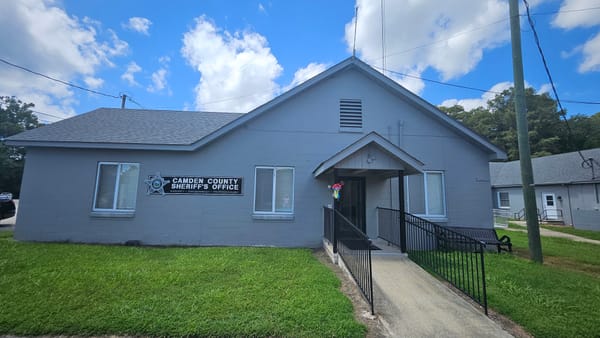
Camden Tribune went inside the Sheriff's Office with Sheriff Kevin Jones. What emerged was a picture of an agency making an old building work and a sheriff arguing that Camden's growth will eventually force wider choices.

This audio narration was generated by Camden Tribune using the open-source Kokoro speech model.
Quick Take
- Sheriff J. Kevin Jones invited Camden Tribune inside the Sheriff's Office for an on-the-record look at the building's space, storage and equipment limitations.
- Case files dating to the 1980s remain in an unconditioned attic, while rooms throughout the building have been repurposed as the agency has grown.
- Camden County says it intends eventually to expand the Sheriff's Office into the neighboring senior center, but a detailed renovation cost and formal space-needs study have not been presented publicly.
- Camden currently has no automated license plate readers, and Jones says residents will be consulted before he pursues them again.
CAMDEN, N.C. — Upstairs in the Camden County Sheriff's Office, decades of criminal case files sit in cabinets and boxes beneath an unconditioned roof.
Sheriff J. Kevin Jones pointed toward records he said date to the 1980s, then toward the dry exposed wood around them.
“This tinder box up here — if it catches on fire, this whole building, it'll be gone in 30 minutes.”
— Sheriff J. Kevin Jones
Downstairs, the problems are less dramatic but easier to see everywhere.
Two sergeants share an office. A former break room holds evidence. Other rooms have taken on jobs they were never designed to perform. Sheriff's Office employees handle some building work themselves.
Jones invited Camden Tribune inside to show residents something they rarely get to examine room by room: what it takes to operate the Sheriff's Office Camden has today — and what may have to change if the county keeps growing.
An attic full of Camden's past
Jones showed boxes, filing cabinets and shelving containing old case records. There is no climate-control system serving the attic, and he pointed to signs of rodent activity and the effect extreme temperatures can have on paper and other stored material.
“As you see, we're running out of space,” he said.
Jones also questioned whether employees can reasonably be expected to spend extended periods retrieving and organizing records there.
“Can you expect somebody to come up here in 30-degree weather and work up there?”
No fire marshal assessment was presented during the walkthrough, and Camden Tribune has not obtained an independent report concluding that the building presents the level of fire risk Jones described. His statement about the building burning within 30 minutes is his assessment, not an independently established finding.
The records create another question: which must still be preserved, which may eventually be destroyed under state retention schedules and what it would cost to digitize those that must remain available.
Jones anticipated that question himself.
“Why don't you digitize?” he said. “Well, we don't have the money to do it.”
Making an old building do more
The space pressure continues downstairs.
Jones said the office is down a detective position and currently operates with one investigator. Two patrol sergeants share one room.
Probation and parole use space in the building that Jones said his department could otherwise use, although he acknowledged the county is required to provide space for that function. Another room holds county information-technology equipment that Jones said could eventually be relocated.
The former break room has become evidence storage. Rather than purchase a roughly $5,000 safe that Jones believed could fill almost immediately, the department converted an interior room into secure weapons storage using a vault-style door.
The pattern repeats throughout the building: use the space already there, change its purpose and make it work.
Jones said Camden County budgets approximately $15,000 annually for Sheriff's Office building maintenance.
“That's not enough,” he said.
He said Sheriff's Office employees have handled painting, carpet work, carpentry and equipment installation themselves. County maintenance personnel have also performed work, including building shelving used for stored records. Jones said he personally installed an air line for an office compressor.
He stressed that he was not trying to criticize county maintenance employees.
“I'm not bad mouthing, just being real. If we wait on them to do it, it doesn't get done.”
The Tribune has not calculated how many employee hours the Sheriff's Office spends on building work or what that labor would cost if performed through county maintenance or contractors.
Finding money somewhere else
Jones described grants and outside programs as ways to obtain equipment without returning to commissioners for every purchase.
“That's how we survive, is grants and stuff,” he said.
The department's 18-foot Parker patrol boat is one example. Jones said money remaining from a state vehicle appropriation allowed the office to buy the used boat for about $15,000. He brought someone familiar with Mercury engines to inspect it before purchase, including a compression check.
Jones later clarified that the type of turnkey replacement he would want today could cost roughly $156,000. Rather than ask county taxpayers for that amount, the department is pursuing a FEMA Port Security Grant.
“I'll be shocked if we get it.”
The Sheriff's Office also participates in the federal LESO/1033 surplus-property program. Defense Logistics Agency guidance says participating law-enforcement agencies do not pay for transferred property itself, although they can incur shipping, acquisition, maintenance and other costs.
Jones described a local account associated with surplus-property transactions that he estimated at about $40,000 and said is available for equipment needs. Camden Tribune has not independently established the precise legal restrictions governing that account and is seeking the underlying county and state financial rules.
Other purchases reflect the same effort to stretch resources. Jones said the department adopted body-worn cameras before state law required his office to do so and recently replaced an obsolete fingerprint machine used for permits, employees and public fingerprinting services.
His assessment of body cameras was simple:
“It's protected us more than it's hurt us.”
The $77,000 Camden didn't spend
One of the more revealing decisions Jones described involved equipment that never arrived.
About two years ago, he said, Camden County approved approximately $77,000 for seven automated license plate readers, commonly called ALPRs.
Jones was considering Flock Safety.
He never bought them.
At the time, Jones said uncertainty remained over placing the cameras along state-maintained rights-of-way. He did not want to spend the appropriation and later discover that investigators could not deploy the equipment where they needed it.
“I can't take a chance on spending taxpayers' money.”
“We wanted to let all the litigation get aired out and decided by a judge before we wanted to invest taxpayers' money into it,” Jones said.
In a later follow-up call, Jones clarified that the unused appropriation returned to Camden County's general fund and was subsequently appropriated for other county purposes. It is no longer part of the Sheriff's Office budget, he said.
North Carolina has since created a statutory mechanism for law-enforcement ALPR placement within state-maintained rights-of-way. That change addresses the state-road deployment problem Jones said caused him to stop the purchase, although broader debates over privacy, data access and appropriate use of ALPR technology remain.
Jones also stopped to make a distinction that has become important in the regional debate.
“Flock is a particular brand. It's not the name of all the cameras.”
He compared it to calling every motorcycle a Harley.
Flock Safety is one vendor. ALPR is the underlying technology.
Jones said he preferred Flock because nearby jurisdictions use the same platform, potentially allowing investigators to search for suspect vehicles across jurisdictional lines.
He described a burglary as an example: investigators could identify vehicles that passed during a known time window, compare them with witness descriptions and develop leads for further investigation.
“We don't care nothing about monitoring people where they go,” Jones said.
Camden has no deployed ALPR cameras, according to Jones.
What has changed since the original proposal, he said, is the amount of public attention surrounding the technology.
Before pursuing cameras again, Jones said:
“I'm gonna get a general consensus of what the people think.”
He tied that directly to whether residents support moving forward.
“Ultimately I'm spending their money. I think they should have some say so.”
That gives Camden residents a clear accountability benchmark for any future ALPR proposal: Jones says public sentiment will be sought before he tries again.
The answer may be next door
The longer-term space solution may not require building a completely new Sheriff's Office.
Jones hopes the department eventually can expand into the neighboring senior center after the county completes a replacement Parks and Recreation and Senior Center.
County Manager Erin Burke has publicly described the same plan.
“Following completion of the new center, the County will renovate the old center to meet the needs of the Sheriff's Office,” Burke wrote in July.
What has not yet been presented publicly is a detailed Sheriff's Office renovation scope, final cost or construction schedule. Burke has also said no formal facilities or space-needs analysis has been completed for the department.
The county therefore knows where it expects the Sheriff's Office to expand. It has not yet publicly established exactly what that renovation will require.
Why It Matters
Jones's argument goes beyond the condition of the current building. He says Camden's growth will eventually require the county to decide how much law-enforcement capacity it is willing to support.
“I don't care who's sitting behind the sheriff's desk. The crime rate is going to increase as the population increases. It's inevitable. You're going to have to fund my office, or whoever's office it is, to combat that problem.”
— Sheriff J. Kevin Jones
Jones's prediction that population growth will necessarily bring more crime can be tested over time against Camden's crime and population data. The more immediate question is already before county leaders: Camden plans to give the Sheriff's Office additional space, but the cost, scope, and long-term staffing and equipment needs have not yet been established publicly.
For residents, that turns an aging-building problem into a larger budget question: What level of law-enforcement service does Camden need as it grows, and what are taxpayers willing to spend to provide it?
Questions Camden residents can ask
The walkthrough leaves decisions that have not yet been resolved. Residents who want to follow what happens next can ask:
For the Camden County Board of Commissioners
- Will the county conduct a formal Sheriff's Office space-needs assessment before designing the proposed senior-center renovation?
- What will the renovation cost, and when will the public see a proposed scope, budget and timeline?
- Has the attic been formally evaluated by the fire marshal, county insurer or records-management staff for fire risk, environmental conditions and records storage?
- If ALPRs return to the county budget, what public process will occur before money is approved?
- What safeguards would commissioners require before approving an ALPR system — including retention periods, outside-agency access, audit requirements and misuse controls?
For Sheriff J. Kevin Jones
- How will he determine whether Camden residents support ALPR cameras? Jones said he will seek a “consensus.” What will that process look like?
- What level of public support would cause him to move forward — or decide not to?
- If ALPRs are proposed again, what limits would he support on data retention, sharing, authorized searches, and auditing?
- What are the Sheriff's Office's most urgent space needs? If additional rooms became available tomorrow, which functions would need them first?
- What additional staffing, vehicles, equipment, or facilities does Jones believe Camden will need over the next several years?
Those questions do not assume that additional spending or an ALPR system is necessary. They give residents a way to measure future proposals against documented needs, costs, and the public process officials say they will follow.
What Happens Next
The county's planned conversion of the existing senior center for Sheriff's Office use still needs a defined scope, cost, and schedule.
Camden Tribune is also seeking additional documentation concerning the Sheriff's Office's facility and financial needs, including whether the attic has received a formal fire-safety or records-management review and what rules govern the surplus-related account Jones described.
If Jones returns with an ALPR proposal, he has said he will seek resident sentiment before moving forward. How that input is gathered — and how much weight it carries — will be a question to watch.
Prior Camden Tribune coverage
This feature continues Camden Tribune's reporting on Sheriff's Office facilities, county capital planning and automated license plate readers:
- Camden Sheriff's Office: No Dedicated Facility Funded Yet — county records documented evidence, equipment and holding-space needs without establishing a dedicated law-enforcement facility project or completion schedule.
- The Sheriff Says Camden's Facility Falls Short. So Why Is the Recreation Center First? — examines why the Parks and Recreation and Senior Center project comes before additional Sheriff's Office space.
- North Carolina Opens State Roads to License-Plate Readers. What Does That Mean for Camden County? — explains the state-law change affecting ALPR placement along state-maintained roads.
- Camden Tribune accepts Sheriff Jones' invitation to tour — explains how the walkthrough that produced this report came about.
Related coverage: Camden Tribune is also reporting on the broader regional debate over Flock Safety and automated license plate readers.
Sources and Reporting Note
- On-the-record walkthrough and recorded interview with Sheriff J. Kevin Jones.
- Follow-up telephone clarifications from Jones.
- Written responses from Camden County Manager Erin Burke concerning Sheriff's Office facilities and county capital planning.
- Defense Logistics Agency guidance concerning the LESO/1033 Program.
- North Carolina law governing automated license plate readers and state-maintained rights-of-way.
Quotation note: Spoken quotations were checked against the recorded walkthrough. Ordinary punctuation and capitalization were supplied for readability without changing the speaker's words or meaning. Where the recording was unclear, the Tribune paraphrased rather than reconstructing a quotation.
Transparency note: Some security-sensitive details concerning access points and storage arrangements were disclosed during the walkthrough and deliberately omitted because publishing them would not materially improve public understanding.
Written by
Continue following this story
More Government Accountability coverage
Currituck approves $5.6 million Carova land purchase, including $1.68 million in tourism tax funds
Currituck plans to spend $5.6 million for roughly 43 acres in Carova, including $1.68 million from occupancy taxes. The county says the property would provide public water access and outdoor recreation.N.C. Ferry Tolls: Hanig Tried to Remove Them. 25 Senators Voted to Stop the Effort
North Carolina's ferry-toll mandate emerged in the Senate, survived an effort to remove it, disappeared from the House budget, and returned in the final agreement. The legislative record names the lawmakers involved but not who restored the statewide requirement.
Five-Year ICE Contract Signed for Rivers; Hertford Commissioner Cites Jobs, Limited County Role
GEO has signed a five-year ICE contract for the 1,320-bed Rivers Facility in Winton. A county commissioner points to jobs, while staffing, local costs and the county’s role remain under examination.
ICE Plans 1,400-Bed Detention Center at Rivers; Camden Tribune Seeks County Records
ICE reportedly plans to reopen Rivers Correctional Facility in Winton as a 1,400-bed immigration detention center. Camden Tribune has requested county communications, permits and agreements concerning the project.
B&M schedules mining-permit meeting; Camden says no application is on file
B&M’s September 23 meeting concerns a proposed mining permit at 399 Ponderosa Drive. Camden says no application is on file; attendance questions remain.
Sawyer Says South Mills Development Could ‘Outrun’ Sewer Plant as Moratorium Nears End
South Mills wastewater averaged about 25% of stated capacity in July, while Camden says proposed development will require substantially more treatment capacity.
Camden Board Backs Posting Delinquent Taxpayer Names on Social Media for ‘Extra Pressure’
Camden commissioners backed posting delinquent-tax information on county social media after the county manager said broader exposure could add “a little extra pressure” to pay.