Camden's Water and Sewer Warnings Span 20 Years. Commissioners Just Approved Another Three-Year Moratorium.
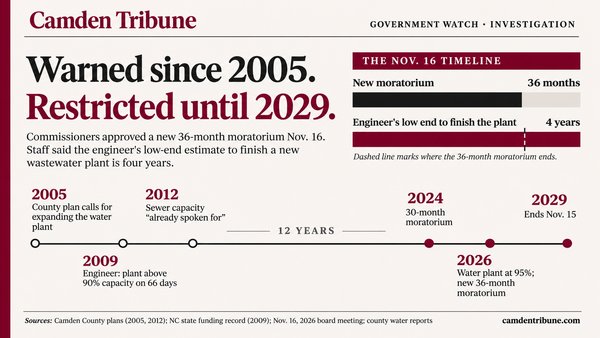
Camden's 2012 plan said wastewater capacity was already spoken for. Commissioners approved 36 more months, even as staff cited four years to finish a wastewater plant.

This audio narration was generated by Camden Tribune using the open-source Kokoro speech model.
Disclosure: Camden Tribune publisher Francisco Salmeron was elected to the Camden County Board of Commissioners on Nov. 3 and is scheduled to take office Dec. 7. He did not participate in the moratorium votes.
The Tribune's reporting and records requests are separate from his future duties as a commissioner. See the Tribune's ethics policy.
CAMDEN, N.C. Camden County commissioners approved another three years of restrictions on subdivisions and multifamily development Monday, after decades of county planning documents warned that the county's water and sewer systems would need more capacity.
The latest vote came with an uncomfortable deadline: County Manager Erin Burke said the engineer's shortest estimate to complete a proposed wastewater plant is four years. The county chose a 36-month moratorium because it hopes construction can begin earlier and new homes will take additional time to reach occupancy.
That calculation affects landowners, builders and residents who depend on existing water service. It also returns attention to a much older question: what happened to the improvements and allocation policies Camden had been discussing long before the first moratorium was adopted in 2024?
2005: A water expansion and a sewer plan
Camden's 2005 land-use plan, adopted April 4 of that year, described a reverse-osmosis plant with 576,000 gallons of daily capacity and proposed expanding it to twice that amount. The plan estimated the expansion at $4 million and also outlined a 300,000-gallon elevated water tank for South Mills.
The same document referred to a 2001 sewer study and a proposed county sewer system. It described collection lines, land application and additional service to South Mills, including plans that depended on securing money and accommodating growth.
Those plans are evidence of long-standing infrastructure priorities. They do not establish which individual projects were later funded, redesigned or finished.
2009: An engineer warned the plant was running hard
Camden sought approximately $2.58 million through a 2009 federal stimulus drinking-water program to increase treatment capacity from 720,000 to 1.4 million gallons per day. The state funding list classified the proposal as ineligible under that program because officials considered it an expansion for future growth.
Todd Tripp, an engineer with McGill Associates working on Camden's proposal, objected. In correspondence included in the state record, he said the plant had operated above 80% of capacity on 152 days and above 90% on 66 days in the preceding year.
Tripp also described a lack of treatment redundancy and quoted plant staff: “We can't service the system the way we would like because the plant is always running.” His figures were assertions in a contemporaneous engineering submission, not a separate state audit.
The state said revised applications could be considered in another round. The available records do not establish whether Camden secured replacement financing under that application.
2012: Wastewater capacity was “already spoken for”
The county's 2012 Comprehensive Plan gave a much more pointed assessment of wastewater needs.
It reported that South Mills' 100,000-gallon-per-day wastewater plant was receiving 20,000 to 25,000 gallons daily, but planned connections to homes with failing septic systems would use another 35,000 gallons. A 2010 McGill master plan had also identified 48,000 gallons per day committed to existing or developing residential and business uses.
The 2012 plan concluded that available treatment capacity was “already spoken for.” It separately identified approximately 270 households in three nearby communities needing centralized sewer service and estimated they would require 73,000 more gallons per day of treatment capacity.
The county proposed formal policies for allocating limited water and sewer capacity. It also called for capital-improvement priorities, public-private partnerships and a long-term strategy for failing septic systems.
Those recommendations were not merely forecasts of distant growth. They addressed service commitments and existing households already needing infrastructure, more than a decade before Monday's vote.
One expansion figure that needs an explanation
The 2012 plan also reported that a recent expansion had increased the South Camden drinking-water plant's capacity to 1.44 million gallons per day with its two treatment trains. The plan said a third train and a new building would eventually be needed to preserve redundancy as demand approached that capacity.
By contrast, the district's 2025 Local Water Supply Plan lists the plant at 0.720 million gallons per day. That state filing also reports production above 90% of approved plant capacity for five consecutive days, no active leak-detection program and no active conservation public-education program.
The two capacity figures may reflect different engineering assumptions, treatment-train operating requirements or subsequent regulatory limits. They cannot fairly be read as proof that the earlier expansion was never built, but Camden has not yet provided a reconciliation in the records examined for this report.
In October 2026, Public Works Manager Charles “Chas” Sawyer reported that the water plant had averaged 681,516 gallons a day in August, approximately 95% of the 720,000-gallon daily capacity then cited by the county. His update said replacing reverse-osmosis membranes improved efficiency without increasing the plant's stated capacity.
2023–2026: Money and work, but no completed new wastewater plant
The General Assembly directed $10 million to Camden water and wastewater infrastructure in 2023. Later state project allocations listed $3.94 million for a drinking-water clearwell and $5.91 million for the Burnt Mills wastewater project; the actual amounts spent and reimbursed require separate accounting.
In May 2024, commissioners approved a $65,000 Timmons Group preliminary engineering proposal for the South Mills wastewater expansion. The next month, the board imposed a 30-month moratorium, citing limited water production and wastewater treatment capacity.
Engineering, sampling, regulatory discussions and clearwell design progressed during the moratorium. As August ended, however, the proposed new wastewater discharge had not reached a formal permit application.
Camden also requested an extension in July 2025 for its clearwell plans, moving a December 2025 deadline to November 2026. The plans were eventually submitted Aug. 28, 2026, making subsequent state review a separate question from the time spent preparing them.
Who was waiting on whom
At the Nov. 16 hearing, county officials repeatedly pointed to state permitting. One speaker called it “really the biggest driving point,” while another said “a lot of this is really dependent upon DEQ.”
One speaker hoped Camden and DEQ staff would be “able to be responsive.” The discussion also described a lobbyist who could go to Raleigh and DEQ “to get us answers to keep that pressure on them.”
County Manager Erin Burke said the state needed to be a partner rather than an impediment, adding: “And thus far, we're lacking in the partnership world.”
DEQ's written chronology describes substantial contact with Camden. County representatives presented possible wastewater discharge locations in June 2024, DEQ approved a Pasquotank River modeling plan in May 2025, and Timmons Group presented preliminary results in July 2026.
But on Aug. 26, DEQ wrote that it was “waiting on model plan report and files” from Timmons. The consultant had indicated that the completed model report and files would be submitted “soon,” and regulators needed that work before reviewing the results and moving toward discharge limits.
Sawyer had told commissioners Aug. 3 that pending state approvals “have taken a lot longer due to staffing issues.” An Aug. 8 regional news report also quoted him saying he urged DEQ to expedite the NPDES permit process rather than wait the full 24 months.
On Aug. 27, DEQ deputy communications director Josh Kastrinsky gave a different account: “As no permit applications have been formally submitted, there is not a delay in timeline. DEQ staffing has not impacted the regulatory process.”
Sawyer could request faster preapplication work before filing a formal application. What the August documents do not establish is that DEQ was delaying review of a completed wastewater permit application.
The clearwell followed a separate review schedule. Camden submitted those plans Aug. 28; in October, Sawyer reported that the state had told the county who was reviewing the plans, but the county had not heard back.
The unresolved question is not whether Camden and DEQ communicated. It is which party was waiting on which submission at each stage, and whether any written requests remained unanswered.
The November vote: Three years to start, four years to finish
County Manager Erin Burke described four years as the engineer's “low end” and clarified: “That's to the completion of a wastewater plant.”
Commissioner Sissy Aydlett said the county hoped to reach construction within about 24 to 27 months, before the new restrictions expire. Officials did not say when the four-year estimate begins.
Board Chairman Dr. Jason Banks said the county had already approved enough housing to be behind on its infrastructure needs. Responding, a county official told the board that when those projects are fully developed, “the county will be out of capacity.”
The warning concerned future demand from those projects, not a finding that existing customers had already exhausted available capacity.
During the legal review, county attorney Lauren Arizaga-Womble described water and wastewater project summaries intended to document completed and continuing work under the previous moratorium. When discussing the attachments, Arizaga-Womble said: “I don't think there's anything attached.”
The board adopted the draft ordinance as amended and then separately authorized the chairman to sign the final version. Counsel referred to completing the amended section “when I can type in that section.”
Under N.C.G.S. § 160D-107, a development moratorium must state its corrective actions and schedule at adoption. The meeting record establishes the sequence of amendments and votes, but the signed ordinance and incorporated exhibits are necessary to determine exactly what became part of the adopted measure.
A new moratorium, or an extension?
County attorney Lauren Arizaga-Womble said “it is our position that this is a new moratorium” and described additional findings for the possibility that a court treated it as an extension or renewal. State law imposes added conditions on a renewal, including reasonable and feasible corrective steps under the earlier ordinance and new facts justifying more time.
The predecessor's identity needs checking. Commissioners held hearings in June 2025 on a possible 18-month replacement that would exempt transfer plats and rescind the 2024 measure, but the hearing notice alone does not establish adoption.
The county's published ordinance index lists the 2024 ordinance, and the Tribune's October report described the moratorium as the 30-month measure set to expire Dec. 25, 2026. Neither explains why counsel referred to a “2025 moratorium” during Monday's hearing.
The county identified infrastructure concerns, including water pressure, fire-flow limitations and capacity already committed to approved developments. Board Chairman Dr. Jason Banks said the problem had “been creeping up for quite a while” and “been kicked down the road because of expense and time.”
The accounting Camden still needs
Sawyer did not respond to written questions the Tribune sent Aug. 5 and Sept. 16. County Manager Erin Burke did not respond to the Sept. 16 questions.
A project-by-project ledger could establish what was promised under the 2024 restrictions, what was completed, how much state funding was used and whether approved developments have been assigned more water or wastewater capacity than the systems can safely provide. The final engineering schedules would also show whether the 2029 deadline rests on an achievable sequence of permits, bids, construction and operations.
Camden has now voted for another three years. Its records show the warning began more than 20 years ago; what remains to be established is whether the work undertaken since then will finally keep pace with the commitments county government has made.
Earlier coverage
- Camden to Consider Hearing on 36-Month Subdivision Moratorium as Current Pause Nears End (Oct. 22)
- Camden water project still awaits state OK two months before the moratorium ends (Oct. 22)
- Sawyer Says South Mills Development Could ‘Outrun’ Sewer Plant as Moratorium Nears End (Sept. 16)
- Camden’s 30-Month Moratorium Nears End. DEQ Is Still Waiting on the Wastewater Model (Aug. 26)
Sources and transparency
This investigation draws on Camden's 2005 land-use plan, North Carolina's 2009 drinking-water stimulus funding record, Camden's 2012 Comprehensive Plan, the district's 2025 state water-supply filing, the county's ordinance index, direct DEQ correspondence from August 2026, a transcript of the Nov. 16 meeting, and prior Camden Tribune reports on the wastewater modeling delay and the Timmons engineering vote.
Speaker identifications were confirmed against the county's Nov. 16 meeting video; the separate transcript begins after a recess. The signed Nov. 16 ordinance, the June 2025 hearing outcome, actual expenditures and the project deliverable schedule have not yet been independently verified for this report.
Written by
Continue following this story
More Government Watch coverage
Camden to Consider Hearing on 36-Month Subdivision Moratorium as Current Pause Nears End
Commissioners meet on October 22, 2026, to consider setting a November 16 hearing. The notice does not say whether the 36 months would extend the current moratorium or start a new one.
Camden Yacht Club Disputes $4,800 Trash Fee, Asks Why County Rejected Land Offer
Commissioners send marina fee policy to November as club seeks answers about the county-owned waterfront property it leases.
Paid Camden's Solid Waste Fee? You May Be Owed a Refund
Only a couple of people applied before the July 30 deadline. Commissioners told staff to accept applications on a rolling basis and find people who already paid.
Rural health care has to change. Eastern N.C. can show the nation how.
ECU Health CEO Dr. Michael Waldrum says rural health care must look different, and that eastern North Carolina, starting with Martin County’s planned Rural Emergency Hospital, can show other regions what comes next.
The Voters Have Spoken. We Should Stay Home.
Rep. Rodney D. Pierce, D-Halifax, argues that North Carolina’s outgoing Republican legislative majority should not use this month’s lame-duck session to reshape state government before newly elected legislators take office.
Veterans Day in Camden: A Heartfelt Thank You
Today, Camden County says thank you to every veteran who served our nation, came home, and continued serving their families, neighbors, and community.