Dare Commissioners Vote Unanimously to Remove Flock License Plate Cameras
Dare County voted unanimously to remove 14 sheriff-operated Flock cameras, despite law enforcement saying the system had helped solve serious crimes.

This audio narration was generated by Camden Tribune using the open-source Kokoro speech model.
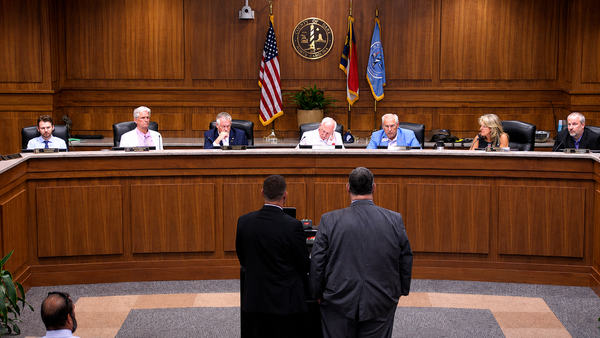
MANTEO, N.C. — Dare County commissioners voted Tuesday unanimously to remove all 14 Flock Safety license plate cameras operated by the Sheriff's Office, ending the county-controlled portion of a network that detected 324,884 unique vehicles in the previous 30 days.
The board acted after hours of public comment and questioning that exposed both sides of the system: deputies said Flock had helped solve serious crimes and locate suspects, while the same presentation showed how broadly the cameras collect and share vehicle information.
Dare conducted 42 searches and received 110 NCIC alerts during the 30 days ending Aug. 28, according to the Sheriff's Office. The cameras were also shared with 204 law-enforcement agencies in North Carolina and 1,325 outside the state.
Sheriff Doug Doughtie took no position on whether the county should keep them.
"If you vote to take them down today, they'll come down just that quick," he told commissioners.
They did.
324,884 vehicles, 42 searches
Dare County has used automated license plate readers since 2014. The Sheriff's Office moved to Flock Safety in July 2023 with eight cameras and expanded to 14 in 2025.
The cameras take still photographs of passing vehicles and license plates. The Sheriff's Office said its units do not record video or perform facial recognition. Data is retained for 30 days.
Seventy users had access to Dare's system. Twenty-nine could search it, limited to administrators, investigators and patrol supervisors. A search requires an offense type, reason, and case number, Deputy Sheriff Master Officer Tyler Dowdy told commissioners.
The Sheriff's Office said administrators review system audits monthly and that no authorized user had been identified using Flock for personal purposes or in violation of department policy.
In the 30-day snapshot presented to commissioners, Flock detected 324,884 unique vehicles while users performed 42 searches.
The system also generated 110 NCIC alerts, including 36 involving stolen license plates, 35 stolen vehicles, 22 protection orders and 12 active warrants. Three alerts involved gang or suspected-terrorist flags.
Doughtie and Dowdy said the system had "tremendously helped" law enforcement.
But when a commissioner asked what percentage crime had dropped since Dare began using license plate readers in 2014, Dowdy said he could not put a percentage on it. He pointed instead to wanted suspects, stolen vehicles, stolen plates and individual cases where the cameras contributed to an investigation.
The cameras were part of a much larger network
Dare's 14 cameras did not operate as a closed county system.
The Sheriff's Office said it shared its Flock network with 204 law-enforcement agencies in North Carolina and 1,325 outside the state. In the other direction, 240 North Carolina agencies and 1,428 out-of-state agencies shared access with Dare.
Deputies said Dare shared nothing with federal agencies.
That network matters to how the Sheriff's Office uses Flock. An investigator searching for a suspect vehicle can query participating cameras outside Dare and, when sharing is enabled, another agency can receive an alert when its target passes a Dare camera.
Asked whether Dare could keep Flock but stop sharing with other agencies, Dowdy said it could.
He also said doing so would defeat much of the system's purpose because Dare relies on other agencies' cameras during investigations.
It would "cripple our system essentially," Dowdy said.
Commissioners also pressed the Sheriff's Office about public oversight.
Asked how much information about the system's use could be released to the public, Dowdy said the information involved criminal investigations and was sensitive.
"As far as what's able to be released to the public, not much," he said.
Dowdy, Sgt. Johnson and Chief Deputy Derringer administer Dare's Flock account and audit users with search privileges, he said.
Sheriff's Office points to cases where Flock worked
The strongest case presented for keeping the cameras was not theoretical.
In the Avalon Pier murder investigation, a witness had only a partial license plate and description of a vehicle. Deputies said investigators used Flock to identify the correct make, model, and license plate, verified the vehicle through other law-enforcement databases, and later received an alert when it returned to the area.
That helped lead investigators to the suspect.
The Sheriff's Office also cited stolen-vehicle recoveries, wanted-person cases, missing persons, drug investigations and a trespassing case at Manteo Elementary School.
The system therefore presented commissioners with a direct tradeoff. The Sheriff's Office could point to cases where the technology worked, and it reported no identified local misuse. Residents were asking the board to reject the collection system itself.
Andrea O'Donnell of Kitty Hawk, organizer of Deflock Dare, told commissioners a petition calling for action had reached about 750 signatures.
O'Donnell said she had counted 48 static Flock cameras across multiple Dare County agencies. The Sheriff's Office confirmed only the 14 cameras it controls and told commissioners municipal police departments operate their own systems.
The meeting did not establish a verified countywide total.
That distinction remains important: Tuesday's vote affects the Sheriff's Office cameras in unincorporated Dare County. It does not remove cameras controlled by the county's towns.
Commissioners choose removal
Commissioners did not reject the Sheriff's Office's account that Flock had helped investigators.
Their decision turned instead on whether those benefits justified keeping the system.
Mike Burrus called the cameras intrusive and said he was prepared to remove the 14 under county control.
Carson Creef praised the Sheriff's Office but raised concerns about the wider network, Flock's role as a private technology company, and unresolved constitutional questions. He said opposition was coming from both Republicans and Democrats and argued Dare's deputies had policed effectively before Flock.
Rob Ross gave the clearest statement of the board's dilemma.
He said some crime victims who benefited from the cameras were not represented during public comment and accepted the Sheriff's Office's account that Dare had not abused the system.
Still, Ross said the technology was viewed as an "egregious overstep by our government."
He initially moved to turn the cameras off immediately.
The discussion then shifted to whether leaving inactive cameras standing would address the public's concern. Ross amended his motion to require physical removal "as soon as practical."
The cameras are leased under an annual contract. Commissioners were told they cost about $3,000 each, putting the 14-camera system at roughly $42,000 a year. The current annual fee has already been paid, so removing the cameras does not recover that money.
The board unanimously approved the amended motion.
Doughtie said the Sheriff's Office could have the cameras down within about two weeks.
The vote removes Dare County's 14 sheriff-operated cameras. Flock systems operated separately by municipal police departments remain outside the county board's action.
Written by
Continue following this story
More Dare County coverage
Dare commissioners advance up to $67 million in financing, approve Hatteras child-care aid
Dare County advanced financing for three public projects and approved child-care assistance, referendum outreach, and a water-capital amendment at an Aug. 10 special meeting.
B&M schedules mining-permit meeting; Camden says no application is on file
B&M’s September 23 meeting concerns a proposed mining permit at 399 Ponderosa Drive. Camden says no application is on file; attendance questions remain.
Sawyer Says South Mills Development Could ‘Outrun’ Sewer Plant as Moratorium Nears End
South Mills wastewater averaged about 25% of stated capacity in July, while Camden says proposed development will require substantially more treatment capacity.
Camden Board Backs Posting Delinquent Taxpayer Names on Social Media for ‘Extra Pressure’
Camden commissioners backed posting delinquent-tax information on county social media after the county manager said broader exposure could add “a little extra pressure” to pay.