
Camden’s Moratorium Record: 600-Signature Claim Was Unverified, Minutes Show
Camden County minutes show an approximately 600-signature Facebook survey supporting a moratorium had not been checked for duplicates. Nearly two years after the county imposed its 30-month development pause, the wastewater expansion remained in modeling and permitting.

This audio narration was generated by Camden Tribune using the open-source Kokoro speech model.
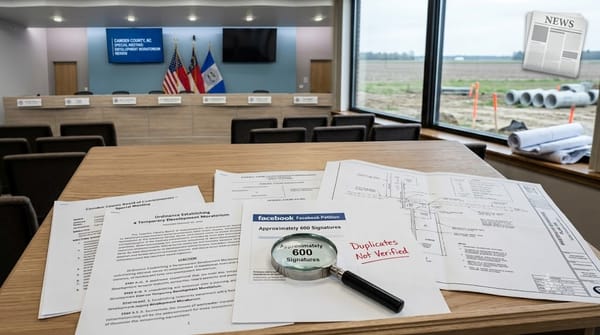
County minutes say no one had checked a Facebook survey for duplicate signatures. Later records show that infrastructure findings—not the petition—became the formal basis. The 30-month pause now faces a federal challenge.
CAMDEN, N.C. — Camden County adopted its 30-month development moratorium in June 2024. Nearly two years earlier, commissioners heard that approximately 600 people had signed a Facebook survey supporting such a measure.
The official minutes also recorded a significant qualification. No one had examined the signatures for duplicates.
Camden Tribune reviewed county minutes, agenda packets, the moratorium ordinance, later project updates and federal court filings. The records reviewed did not include a verified signature list.
The record does not establish that Camden County collected the signatures. It also does not show that officials confirmed residency or relied on the survey as the ordinance’s legal basis.
Instead, the formal 2024 record cites water production and wastewater treatment capacity. It also cites permitting and the time needed to build new infrastructure.
Quick Take
- On Oct. 3, 2022, Jason Banks of Shiloh told commissioners that a Facebook survey had gathered approximately 600 signatures supporting a moratorium.
- The same minutes say no one had examined the signatures for duplicates or otherwise verified the count.
- In March 2024, commissioners initially agreed to research a possible 24-month moratorium. Staff later recommended 30 months.
- The final ordinance cited water and wastewater constraints, not petition signatures.
- It promised a project-status report at every commissioners meeting beginning in August 2024.
- County records from 2026 show movement in engineering, modeling and permit preparation, but the wastewater expansion had not reached bidding, construction or operation.
- A federal complaint directly challenges the adoption and application of the moratorium. The allegations have not been proven in court.
What the 2022 Minutes Actually Say
During public comments on Oct. 3, 2022, Banks presented material supporting a moratorium. The minutes say he cited a Facebook survey with approximately 600 signatures.
The minutes immediately add that no one had examined the signatures for duplicates or similar problems.
Other residents also spoke in favor of a moratorium and referred to a petition. Their comments focused on schools, emergency services, flooding, water and sewer capacity, and preserving the county’s rural character.
The minutes prove that someone publicly cited the signature total. They do not prove that 600 unique Camden County residents signed.
The minutes also do not show that the county received the data or authenticated the petition.
What Camden Tribune Did Not Find
The official records reviewed did not include a petition export or a list of signers. They also lacked a duplicate review, residency analysis, or certification of the count.
That absence does not prove that no such records exist. It means Camden Tribune has not located them in the official material reviewed and cannot independently verify the number.
Public support and legal authority are different questions. A petition may create political pressure.
North Carolina law does not make a citizen-signature threshold the legal foundation for a development moratorium.
How a Possible 24-Month Pause Became 30 Months
County records show that the formal process accelerated in 2024.
| Date | Official record |
|---|---|
| March 19, 2024 | The Board heard a public-works presentation on water and wastewater usage. It then agreed by consensus to research a possible 24-month moratorium. |
| May 6, 2024 | The Board voted 4-1 to direct staff to begin the moratorium process. The stated reason was limited wastewater-treatment capacity. |
| May 22, 2024 | The Planning Board voted 6-1 to recommend a 30-month moratorium on new subdivisions and multifamily development. |
| June 25, 2024 | The Board adopted Ordinance 2024-06-02, beginning a 30-month moratorium and setting Dec. 25, 2026, as its termination date. |
The staff memorandum said early permitting and design could take two to two-and-a-half years. It also said the wastewater plans had reached 65% completion.
The plant location and disposal method would determine the remaining engineering work.
Those projected timelines—not the 2022 petition—were used to support the requested 30-month duration.
The Ordinance’s Formal Basis
North Carolina General Statute §160D-107 sets the required findings for a moratorium. They include the problem, alternatives, covered approvals, and termination date.
The law also requires corrective actions and a schedule for those actions.
Camden County’s ordinance covered residential subdivisions and multifamily uses. It described existing water and wastewater capacity as dangerously close to exhaustion.
The county said the pause would provide time to obtain funding, permits and property. It also aimed to allow construction of new facilities.
The ordinance does not cite the approximately 600 signatures as a required finding or formal justification.
The County Promised a Status Report at Every Meeting
Ordinance 2024-06-02 contained a specific public-accountability commitment. It said the county manager would report the project’s status at every Board of Commissioners meeting beginning in August 2024 and continuing until the work concluded.
That promise creates two separate accountability questions: whether an update appeared at every meeting, and whether the work described in those updates materially increased Camden County’s water or wastewater capacity.
The records reviewed for this report show repeated updates, especially in 2026. They do not yet establish that a report appeared at every commissioners' meeting from August 2024 forward. Camden Tribune is continuing a meeting-by-meeting review through Camden Civic Lens and the county’s official agendas and minutes.
Has the Needle Moved?
Yes, but primarily in studies, design, modeling and permit preparation. The records reviewed do not show that the county had completed the wastewater expansion, awarded its construction contract or placed new wastewater-treatment capacity into operation by July 2026.
| Project component | Progress reported | What remained unfinished |
|---|---|---|
| Clearwell and water storage | Surveying was completed, tank options were reviewed, and staff reported by May 2026 that engineering and design were complete. In June, staff said the project should go out to bid within the month. | The records reviewed for this article do not identify a completed clearwell, a final construction award or new operating water-storage capacity. The clearwell also does not itself create wastewater-treatment capacity. |
| Wastewater plant or expansion | Staff reported continuing stream modeling, work toward discharge limits and preparation for review by the North Carolina Department of Environmental Quality. | In June, staff said Camden was still at the second permitting step. On July 6, staff said additional permits were still required before bids could be solicited. |
| High-rate infiltration basin | A soil study advanced, and a consultant indicated that converting the current spray field might handle approximately 1 million to 1.2 million gallons per day. | Officials continued to describe the basin as a backup plan. The records reviewed do not show final approval, construction or operating capacity from that alternative. |
| Moratorium exit criteria | The ordinance allowed the moratorium to end early if the underlying conditions were resolved. | The public updates reviewed do not identify measurable thresholds showing exactly when the moratorium could be lifted early. |
In January 2026, staff said a high-rate soil study would begin, clearwell surveying had been completed, and a stream-model meeting was upcoming. In May, the wastewater plant remained under modeling review while the high-rate infiltration option continued as a backup. In June, staff said DEQ recommended allowing two and a half years for wastewater permitting and that state staffing shortages were extending the process.
At the July 6 meeting, Public Works Director Chas Sawyer said the wastewater project still needed additional permits before the county could request construction bids. The July 6 agenda packet contained no written attachment documenting milestones, deadlines, costs or changes from the previous report. It listed only a verbal presentation.
This is consistent with Camden Tribune’s July 12 report, “Camden Wastewater Project Still Awaiting Permits More Than a Year After Moratorium Began.” That report found that the project remained in the permitting stage and had not reached the point where commissioners could compare construction bids, award a contract or debate a final build cost.
The defensible conclusion is that the needle moved administratively and technically. It had not yet moved to completed construction or new operational wastewater capacity.
The Reporting Record Still Needs a Full Audit
Camden Tribune has not yet completed a definitive count showing whether the promised status report appeared at every meeting beginning in August 2024. A missing agenda item would not necessarily prove that no verbal update occurred, but the absence of an update from both the agenda and approved minutes would be significant.
The audit should identify each meeting date, whether a moratorium update appeared, who presented it, whether written material was attached, what new milestone was reported, and whether any previously announced deadline changed.
The Federal Lawsuit Directly Challenges the Moratorium
Allied Properties LLC, Camden Yards LLC and other plaintiffs filed a federal civil-rights complaint on May 22, 2026. They named Camden County and several county officials as defendants.
The complaint calls the moratorium procedurally defective. It alleges that the county failed to satisfy North Carolina’s statutory requirements.
The plaintiffs ask the court to declare the ordinance invalid and unenforceable. They also challenge its application to the Crouse project.
A May 2026 county interpretation appears as an exhibit to the complaint. It says the Crouse project violated the moratorium.
The interpretation cites the project’s residential density and multifamily activity.
These are disputed legal claims, and the court has not ruled on the merits. The latest public docket entry reviewed by Camden Tribune is dated July 9.
That entry gave the defendants through Aug. 7, 2026, to answer or otherwise respond.
The separate federal case filed by B & M Investments concerns the Ponderosa Drive sand-mine permit and enforcement dispute. It should not be described as a second lawsuit directly challenging the subdivision moratorium.
A Separate Records Request Remains Incomplete
Camden Tribune sent a public-records request on March 15 in the separate B & M case. It sought insurance, assigned-counsel, reserve and settlement-related fiscal records.
County Attorney Lauren Arizaga-Womble provided a partial response on March 30. On April 6, she said the county was continuing to gather documents regarding outside counsel and would supplement the production.
The supplied email thread contains no later supplemental production. The county responded, but the promised production remains incomplete.
It would be inaccurate to report that county counsel never answered.
That request also does not resolve the separate questions surrounding the 2022 Facebook survey and its approximately 600 signatures.
Questions That Still Require Answers
Camden Tribune is seeking records and clear answers to the following questions:
- Did any commissioner, county employee or county attorney receive the Facebook survey, petition or underlying signature data?
- Was the list checked for duplicates, county residency, authenticity or incomplete entries?
- Was the petition retained under the county’s records-retention requirements?
- Did the Board, Planning Board or county staff rely on the petition when considering the moratorium?
- Where are the complete schedules, cost estimates, permitting milestones and land-acquisition records referenced in the moratorium materials?
- What specific conditions must be satisfied before the moratorium can be lifted early?
- Does the county still expect the moratorium to end on Dec. 25, 2026?
North Carolina’s Public Records Act requires custodians to furnish copies of public records as promptly as possible. Camden Tribune will publish any responsive records and will update this report with the county’s answers.
How Readers Can Review the Evidence
Camden Tribune reviewed the record through Camden Civic Lens. The searchable index locates exact pages in official county meeting records.
Readers can reproduce key parts of this review by searching these phrases:
approximately 600 signatures24-month moratorium30-month moratoriumreport at each Board of Commissioners meetingMoratorium UpdateCrouse Tract project
Civic Lens is not the official county record. Each result is designed to identify the governing body, meeting date, document type, page number, and original official source.
Why This Matters
The central question is not whether residents had legitimate concerns about growth. County records show that residents raised concerns about schools, emergency services, flooding, water, sewer and rural character.
The accountability question centers on the public record. Did officials preserve and verify the evidence cited as proof of broad support?
Did they document the infrastructure problem, follow the law and complete the promised corrective work?
The moratorium affects landowners, builders, housing supply, infrastructure spending and the county’s long-term development policy. It is also now part of active federal litigation.
Transparency and Corrections Note
This report relies on Camden County minutes, agenda packets and Ordinance 2024-06-02. It also uses federal filings, the public docket, and an email record.
This report labels lawsuit allegations and does not treat them as judicial findings. It treats the missing petition as an unresolved records question.
The absence of that document does not prove that it never existed.
Camden Tribune welcomes corrections, additional documents and first-hand information at [email protected].
Related reporting:
- Camden Wastewater Project Still Awaiting Permits More Than a Year After Moratorium Began
- Eight Years of Warnings Before Camden’s Growth Freeze
- Camden County’s Development Pause: Public Works Director to Update Board
- Moratorium Update: Water Tank Project Remains in Design Phase
- Federal Lawsuit Filed Over Ponderosa Drive Sand Mine Dispute
Written by
Continue following this story
More Government Watch coverage
Sawyer Says South Mills Development Could ‘Outrun’ Sewer Plant as Moratorium Nears End
South Mills wastewater averaged about 25% of stated capacity in July, while Camden says proposed development will require substantially more treatment capacity.
Camden Board Backs Posting Delinquent Taxpayer Names on Social Media for ‘Extra Pressure’
Camden commissioners backed posting delinquent-tax information on county social media after the county manager said broader exposure could add “a little extra pressure” to pay.
Camden’s 30-Month Moratorium Nears End. DEQ Is Still Waiting on the Wastewater Model
Camden imposed a 30-month development moratorium to address water and sewer capacity. With four months left, DEQ says no wastewater permit application exists and it is still waiting on the completed model.
B&M schedules mining-permit meeting; Camden says no application is on file
B&M’s September 23 meeting concerns a proposed mining permit at 399 Ponderosa Drive. Camden says no application is on file; attendance questions remain.
Sawyer Says South Mills Development Could ‘Outrun’ Sewer Plant as Moratorium Nears End
South Mills wastewater averaged about 25% of stated capacity in July, while Camden says proposed development will require substantially more treatment capacity.
Camden Board Backs Posting Delinquent Taxpayer Names on Social Media for ‘Extra Pressure’
Camden commissioners backed posting delinquent-tax information on county social media after the county manager said broader exposure could add “a little extra pressure” to pay.