
Camden adopts staff-drafted data center moratorium amid legal scrutiny
Camden County’s temporary data center moratorium is only the first step. County staff will draft the zoning amendment before Planning Board review and a final commissioners’ vote. Residents are urged to read the proposal and stay involved.

This audio narration was generated by Camden Tribune using the open-source Kokoro speech model.
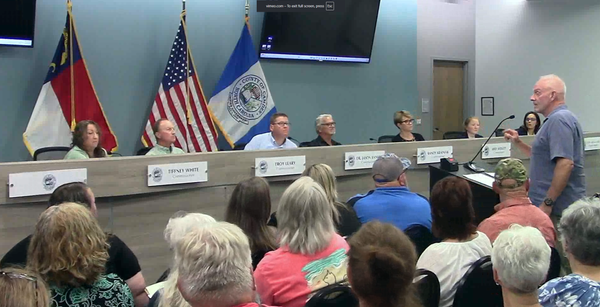
CAMDEN, N.C. — Camden County commissioners voted Aug. 3 to adopt a five-month moratorium on data centers, data processing facilities and cryptocurrency mining operations in the county.
The moratorium took effect immediately and will remain in place through Jan. 3, 2027, or until the county adopts zoning amendments addressing the uses, whichever happens first.
Public testimony was sharply divided. Based on Camden Tribune’s observation of the hearing, speakers were roughly evenly split between those urging protection of Camden’s water, land and rural character and those asking the county not to reject potential jobs, investment and tax revenue without a fuller study.
But one of the most important facts for residents is how the proposal reached the commissioners: the ordinance was prepared and brought forward by county staff.
The proposal reflected staff’s position
County Attorney Lauren Womble explained that the shorter ordinance presented to commissioners represented staff’s view of Camden County’s current legal position.
The county’s Unified Development Ordinance does not presently define data centers, data processing facilities or cryptocurrency mining operations. It also contains no specific development standards for those uses.
Womble said that when a use is not defined, is not listed and is not substantially similar to another use in the ordinance, it creates a legal “gray area.”
“What you have before you … is staff’s perspective of the county’s position right now,” Womble told commissioners.
Staff’s position was that the uses are effectively prohibited already because they are not listed or substantially similar to another permitted use. The five-month moratorium gives staff time to put that position into explicit language by defining the uses and adding them to the county’s list of prohibited uses.
Commissioners made the final decision and remain accountable for the vote. Staff prepared and recommended the policy; the elected board chose to enact it.
County had no rules ready
County Manager Erin Burke acknowledged how recently data centers entered the county’s planning discussion.
Burke said that if someone had asked her 10 years ago what a data center was and how it should be regulated, she would have first asked what a data center was. She said her present concerns are influenced by the experience of friends and neighbors in Northern Virginia, where large data center development has expanded rapidly.
Burke said she now considers the facilities potentially “detrimental to the life and livelihood of those that live adjacent to them.”
Burke also said five months should be enough time for staff to draft language defining the uses and listing them as prohibited. She said staff had already begun moving in that direction and could continue studying the industry after the prohibition was adopted.
Those statements do not establish personal misconduct or legal wrongdoing. They do establish the planning condition confronting Camden County on Aug. 3: the county had no definitions, standards or designated zoning districts ready for these facilities when the issue became urgent.
Krainiak questioned prohibition before study
Commissioner Randy Krainiak questioned why the shorter proposal moved first toward prohibition rather than a broader study of possible standards.
“I’m not looking for a prohibited use,” Krainiak said. “I want to know the facts before I tell them no.”
Krainiak cited reports that data centers can generate tax revenue for host counties. He compared the situation to Camden County’s earlier consideration of solar and wind-energy development, when officials gathered information before deciding how the uses should be regulated.
County officials responded that the prohibition could later be reconsidered through another zoning amendment after further research and public discussion.
Public testimony was nearly evenly divided
Residents presented credible concerns and competing views during the hearing.
Some speakers warned about possible water consumption, electricity demand, industrial noise, effects on neighboring farms and homes, and changes to Camden County’s rural character.
Others argued that data centers can use closed-loop cooling systems, provide significant taxable investment and generate less traffic than large residential developments.
Several residents supported a 12-month moratorium so the county could complete a more comprehensive study before deciding whether the uses should be permanently prohibited. Others opposed a moratorium or urged commissioners to evaluate future projects individually.
The description of public sentiment as roughly evenly divided is Camden Tribune’s observation of the speakers at the hearing. It is not a scientific poll, referendum or official county count.
The moratorium can be challenged
Womble also informed commissioners that a county operating under a moratorium is subject to possible litigation over that moratorium.
That warning is supported by North Carolina General Statute 160D-107.
Under the statute, a person aggrieved by a development moratorium may ask a court to stop its enforcement. Such a case receives expedited review, and the local government bears the burden of showing that it followed the statute’s procedural requirements.
The law does not say Camden’s new moratorium is invalid, and adoption does not mean a lawsuit will necessarily be filed. It does mean the board has enacted another land-use decision that is open to judicial challenge.
Two federal land-use cases already filed
The legal warning carries additional significance because Camden County is already involved in two unrelated federal lawsuits concerning land-use and permitting decisions.
In B & M Investments of North Carolina, LLC v. Camden County, filed Feb. 24, the plaintiff challenges the county’s handling and revocation of a special-use permit for a sand-mining operation. The complaint asserts constitutional and civil-rights claims. A federal judge denied the request for an immediate temporary restraining order but reserved consideration of the request for a preliminary injunction.
The public docket is available through the U.S. District Court docket listing for B & M Investments v. Camden County.
In Allied Properties, LLC et al. v. Camden County, North Carolina, et al., filed May 22, several developers challenge the county’s 2024 subdivision moratorium and related development decisions. The defendants include Camden County, County Manager Erin Burke, Planning Director Hunter Munro, and former Planning and Building Director Amber Curling.
The public docket is available through the U.S. District Court docket listing for Allied Properties v. Camden County.
Both lawsuits remain separate from the data center issue. The complaints contain allegations made by the plaintiffs, not judicial findings that Camden County or any official violated the law.
They are relevant context, however, because both involve recent county land-use or permitting decisions, and the Allied Properties case directly challenges the legality and administration of the county’s earlier development moratorium.
What happens next
Residents should follow every stage of the process
The Aug. 3 vote did not permanently settle how Camden County will regulate data centers, data processing facilities or cryptocurrency mining operations.
County staff, who prepared the moratorium proposals presented to commissioners, will now prepare the proposed Unified Development Ordinance text amendment. Staff has indicated that the initial amendment will define the three uses and list them as prohibited.
The proposed language must then be submitted to the Camden County Planning Board for review and comment before returning to the Board of Commissioners.
It is important to understand the roles of the people and boards involved. County Manager Erin Burke is not the chair or a voting member of the Planning Board. The county’s official roster identifies Steven Bradshaw as Planning Board chairman and Nathan Lilley as vice chairman.
Burke and Planning Director Hunter Munro do, however, serve as ex-officio staff representatives on Camden County’s separate Unified Development Ordinance Review, Revision and Update Committee. That committee is advisory only and has no authority to enact zoning regulations. Its recommendations may be forwarded to the Planning Board and commissioners for consideration.
Under North Carolina law, the Planning Board reviews proposed zoning amendments and makes a written recommendation. The Board of Commissioners is not required to follow that recommendation. The commissioners retain final authority to approve, modify or reject the proposed amendment after holding the required legislative hearing.
Questions residents should ask
Camden Tribune urges residents to review the actual proposed text—not rely only on descriptions offered by supporters, opponents or county officials—before deciding whether the permanent amendment is appropriate.
Among the questions residents should ask are:
- What independent evidence supports listing every data center or data processing facility as a prohibited use?
- Did staff evaluate alternatives such as designated zoning districts, minimum setbacks, acreage limits or case-by-case special-use permits?
- Will the county establish enforceable limits for water use, electricity demand, generator testing, noise, lighting and environmental effects?
- Could closed-loop cooling, noise mitigation or other modern designs address some of the concerns raised during the hearing?
- What would be the expected tax revenue, employment impact and cost of additional county services?
- Would any proposed facility be required to provide binding information on water, electricity, emergency response, decommissioning and financial responsibility?
- What legal review will be completed before commissioners vote on a permanent prohibition?
- Will the county publish the complete draft, staff research and supporting studies far enough in advance for meaningful public review?
The public hearing was roughly evenly divided. Some residents raised serious concerns about water, power, noise and rural quality of life. Others presented arguments concerning closed-loop cooling, taxable investment, employment and lower traffic volumes compared with major residential development.
Being well informed does not require residents to support or oppose data centers in advance. It requires the county to provide the complete proposal, the evidence supporting it, the alternatives considered and the possible legal and financial consequences before a permanent decision is made.
The moratorium is temporary. The proposed zoning language may have much longer consequences.
Residents should monitor the Planning Board and Board of Commissioners agendas, obtain the proposed amendment when it becomes available, submit written comments and attend the hearings at which recommendations and final decisions will be made.
Follow the public process
- Camden County Planning Board members, agendas and minutes
- UDO Review, Revision and Update Committee
- County agendas, meeting packets and approved minutes
- N.C. General Statute 160D-604 — Planning Board review
- N.C. General Statute 160D-601 — Legislative hearing requirements
Reporting note: This report is based on Camden Tribune’s attendance at the Aug. 3 meeting, the meeting record, county materials, North Carolina law and publicly available federal court dockets. References to pending lawsuits describe allegations and procedural events, not findings of liability.
Written by
Continue following this story
More Government Watch coverage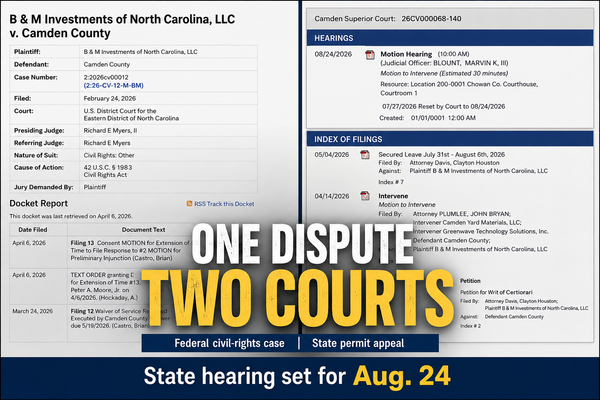
Sawyer Says South Mills Development Could ‘Outrun’ Sewer Plant as Moratorium Nears End
South Mills wastewater averaged about 25% of stated capacity in July, while Camden says proposed development will require substantially more treatment capacity.
Camden Board Backs Posting Delinquent Taxpayer Names on Social Media for ‘Extra Pressure’
Camden commissioners backed posting delinquent-tax information on county social media after the county manager said broader exposure could add “a little extra pressure” to pay.
Camden’s 30-Month Moratorium Nears End. DEQ Is Still Waiting on the Wastewater Model
Camden imposed a 30-month development moratorium to address water and sewer capacity. With four months left, DEQ says no wastewater permit application exists and it is still waiting on the completed model.
B&M schedules mining-permit meeting; Camden says no application is on file
B&M’s September 23 meeting concerns a proposed mining permit at 399 Ponderosa Drive. Camden says no application is on file; attendance questions remain.
Sawyer Says South Mills Development Could ‘Outrun’ Sewer Plant as Moratorium Nears End
South Mills wastewater averaged about 25% of stated capacity in July, while Camden says proposed development will require substantially more treatment capacity.
Camden Board Backs Posting Delinquent Taxpayer Names on Social Media for ‘Extra Pressure’
Camden commissioners backed posting delinquent-tax information on county social media after the county manager said broader exposure could add “a little extra pressure” to pay.