
B&M Sand-Mine Dispute Spans Two Courts; State Hearing Set for Aug. 24
B&M is pursuing a federal civil-rights lawsuit and a separate state permit appeal. Here is how the cases differ and what happens Aug. 24.

This audio narration was generated by Camden Tribune using the open-source Kokoro speech model.
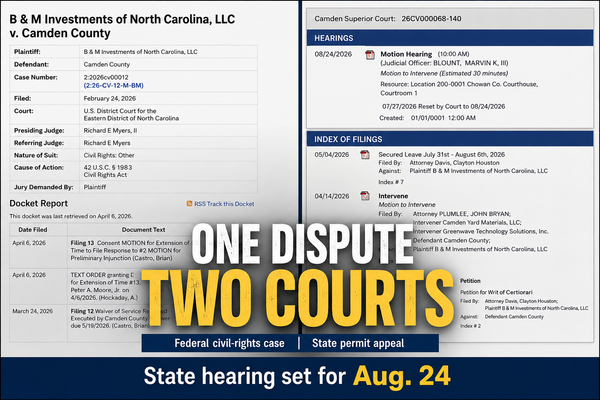
CAMDEN, N.C. — Residents following B&M Investments of North Carolina LLC’s legal dispute with Camden County may encounter two different case numbers, two court systems and several different descriptions of the parties.
Both cases grew from the same controversy over B&M’s sand-mining operation on Ponderosa Road. They are nevertheless separate lawsuits asking different courts to answer different legal questions.
The clearest way to understand the situation is:
ONE DISPUTE, TWO COURTS
Federal court: B&M alleges Camden County violated its constitutional rights through the permit-revocation and stop-work process.
State Superior Court: B&M is asking a judge to review whether the commissioners’ decision to revoke its special-use permit was legally valid and supported by the record.
The next scheduled proceeding is at 10 a.m. Monday, Aug. 24, in Chowan County Superior Court. It concerns a motion by Camden Yard Materials LLC and Greenwave Technology Solutions Inc. to enter the state case.
It is not a hearing in the federal civil-rights lawsuit, and the public state docket does not identify it as the final hearing on B&M’s permit appeal.
The common origin of both cases
Camden County issued B&M Special Use Permit UDO 2016-08-10 in 2017 for mining operations at 399 Ponderosa Road in South Mills.
After a multi-session quasi-judicial hearing in January 2026, the Camden County Board of Commissioners voted unanimously Jan. 29 to revoke the permit and deny B&M’s application to amend it.
The Board’s written order was reviewed and approved March 2. The order concluded that the permit had expired and become null and void.
As an alternative basis for revocation, the Board found that B&M failed to comply with Conditions 7 and 8 of the permit and was operating in a manner that constituted a substantial departure from the approved application, plans or specifications. The Board also found that the anticipated number of truckloads had been misrepresented during the original permit proceedings.
Those are findings made by the commissioners. B&M disputes the County’s actions and is challenging them through the two separate court proceedings.
Case One: The federal civil-rights lawsuit
FEDERAL CASE
Original number: 2:26-cv-00012-BO
Current docket designation: 2:26-CV-12-M-BM
Court: U.S. District Court for the Eastern District of North Carolina
Plaintiff: B&M Investments of North Carolina LLC
Defendant: Camden County
Filed: Feb. 24, 2026
Type: Federal civil-rights and constitutional claims
B&M filed the federal lawsuit Feb. 24, before Camden County completed the final written order documenting the commissioners’ permit decision.
According to the federal court’s Feb. 26 order, B&M asserted claims under the Fourteenth Amendment’s Due Process Clause, the Fifth Amendment’s Takings Clause and two provisions of the North Carolina Constitution.
The federal complaint alleges that Camden County’s permit-revocation and stop-work actions violated B&M’s constitutional rights. A cause of action under 42 U.S.C. § 1983 provides a method for pursuing certain claims that a local government deprived a person or company of federally protected rights.
The federal order recounts B&M’s allegation that Camden County issued a stop-work order around Feb. 4 and that the company ceased mining operations Feb. 5.
The emergency request was denied—but the case was not decided
B&M initially asked the federal court for an emergency temporary restraining order that would prevent Camden County from enforcing the stop-work order before the County could appear and respond.
On Feb. 26, U.S. District Judge Terrence W. Boyle denied the request for immediate, one-sided temporary relief. The judge concluded that B&M had not demonstrated that irreparable harm would occur before Camden County could be heard.
The order did not decide the entire federal lawsuit. It did not determine that all of B&M’s constitutional claims lacked merit, reinstate the permit or authorize mining to resume.
The judge reserved consideration of B&M’s request for a preliminary injunction until Camden County had been served and given an opportunity to respond.
The federal case was reassigned March 23 to Chief U.S. District Judge Richard E. Myers II. The docket directed that subsequent filings use the revised designation 2:26-CV-12-M-BM.
WHY THE FEDERAL NUMBER CHANGED
The suffix “-BO” identified the initial judicial assignment. The later “-M-BM” designation reflects a reassignment within the same federal lawsuit. It does not represent a third case.
A freely accessible federal docket listing reviewed by Camden Tribune was last retrieved by that website on April 6. It shows that Camden County’s response deadline was extended to May 19, but the page expressly warns that a newer docket may be available through PACER.
Camden Tribune is therefore not treating the April 6 third-party listing as a complete statement of the federal case’s status as of Aug. 4.
Case Two: The state permit appeal
STATE CASE
Case number: 26CV000068-140
Court: North Carolina Superior Court
Petitioner: B&M Investments of North Carolina LLC
Respondent: Camden County
Proceeding: Petition for writ of certiorari
Purpose: Judicial review of the permit revocation
After the Board’s written order was approved, B&M separately sought review in North Carolina Superior Court.
A later Camden County filing states that B&M filed its petition for a writ of certiorari March 12 and that the Camden County Clerk of Superior Court entered the writ March 13.
In this setting, a writ of certiorari is the procedural mechanism used to place a local quasi-judicial land-use decision before Superior Court for review under N.C. General Statute 160D-1402.
The entry of the writ does not mean the court ruled in B&M’s favor. It means the case and the commissioners’ record were accepted for judicial review.
The state court will ultimately consider whether the County followed the required legal procedure, applied the correct law and entered a decision supported by the applicable evidentiary standard.
This is generally a review of the proceedings conducted before the commissioners—not automatically a new trial in which every issue starts again from the beginning.
Why the state portal may look different
The public eCourts portal may use generic labels such as “plaintiff,” “defendant” and “complaint.” The actual state filings identify B&M as the petitioner, Camden County as the respondent and the operative proceeding as a petition for a writ of certiorari.
A County certificate of service states that the administrative record delivered to B&M’s counsel contained 473 pages and four video recordings.
Why two other companies want to join
Camden Yard Materials and Greenwave Technology Solutions filed a motion to intervene April 14 in the state Superior Court case.
Camden Yard owns another mining property reached through Ponderosa Road, and Greenwave operates that property under an agreement with Camden Yard, according to their filing.
The companies contend that they share property and easement interests along Ponderosa Road and that those interests could be affected if the commissioners’ decision is overturned.
They were not originally named as parties to B&M’s state appeal. Their motion asks the court to permit them to join under Section 160D-1402 and Rule 24 of the North Carolina Rules of Civil Procedure.
The proposed intervenors ask the state court to:
- Allow them to participate as intervening respondents;
- Affirm the Board of Commissioners’ permit decision;
- Deny B&M’s request for a stay of enforcement;
- Require B&M and its agents to cease sand-mining operations; and
- Accept and join their proposed counterclaim with the state appeal.
The proposed counterclaim contains allegations involving trespass, unfair or deceptive trade practices and contribution toward Ponderosa Road easement expenses. It seeks injunctions, actual and punitive damages, potential treble damages, attorneys’ fees and other relief.
Those are allegations and requests made by Camden Yard and Greenwave. They are not findings by the court.
What happens Aug. 24
SCHEDULED STATE COURT HEARING
Date: Monday, Aug. 24, 2026
Time: 10 a.m.
Matter: Motion to intervene
Estimated length: 30 minutes
Judicial officer: Marvin K. Blount III
Location: Courtroom 1, Chowan County Courthouse
State case: 26CV000068-140
The motion had initially been scheduled for July 27 in Dare County.
Camden County requested a continuance because County Attorney Lauren Arizaga-Womble had a court-ordered mediated settlement conference in another matter and was unavailable that day. The County’s motion states that the other parties consented to the new date.
An amended order moved the hearing to Aug. 24 during the civil session of Chowan County Superior Court.
The immediate issue is whether Camden Yard Materials and Greenwave may enter the state case. If the motion is granted, the companies would become parties and the court would then determine how their proposed claims should proceed. If the motion is denied, they would remain outside B&M’s permit appeal unless further relief is granted.
The supplied state docket does not list a separate date for final consideration of B&M’s underlying challenge to the permit revocation.
How the two cases are connected
The cases share the same central events:
- B&M held a Camden County special-use permit for sand mining.
- The County began enforcement and revocation proceedings.
- The commissioners voted Jan. 29 to revoke the permit.
- The County’s stop-work actions prevented or restricted continued operations, according to B&M’s federal allegations.
- B&M challenged the County through federal constitutional claims and a state permit appeal.
But the legal functions of the cases remain different.
The state judge is reviewing the County’s quasi-judicial land-use decision. The federal judge is considering B&M’s separate allegations that the County’s actions violated constitutional rights.
Because both proceedings concern the same permit and underlying events, a ruling in one may eventually affect issues remaining in the other. Nothing in the records reviewed by Camden Tribune, however, shows that the two cases have been consolidated or that one has replaced the other.
Questions that remain unanswered
The documents reviewed for this report do not establish:
- Whether the federal court has ruled on the preliminary-injunction request since the publicly accessible docket was last retrieved April 6;
- Whether a final hearing on the merits of the state appeal has been scheduled;
- Whether any later court order has changed the current enforcement status of the mine; or
- What additional public expense, if any, Camden County expects from the two proceedings.
In an earlier public-records response, the County stated that it had not directly retained separate outside counsel for the federal litigation and that defense counsel was assigned through the North Carolina Association of County Commissioners’ risk pool.
Camden Tribune sought a current response from County Attorney Lauren Arizaga-Womble regarding the relationship between the two cases, their present status and the Aug. 24 hearing. No response had been received by the publication deadline.
The Tribune will add the County’s response if one is provided after publication.
How readers can follow the cases
The state proceeding may be searched through the North Carolina eCourts services page using case number 26CV000068-140.
The federal case may be searched through PACER using the base case number 2:26-cv-00012. PACER is the authoritative federal docket source and may require an account or fees for some records.
Document note: Camden Tribune reviewed the Camden County Board of Commissioners’ written permit decision, the state motion to intervene and proposed counterclaim, the continuance motions and orders, the state eCourts hearing listing, a federal docket report and the federal court’s Feb. 26 order. Assertions in complaints, motions and proposed counterclaims are allegations unless established by a court ruling.
Written by
Continue following this story
More Government Watch coverage
Sawyer Says South Mills Development Could ‘Outrun’ Sewer Plant as Moratorium Nears End
South Mills wastewater averaged about 25% of stated capacity in July, while Camden says proposed development will require substantially more treatment capacity.
Camden Board Backs Posting Delinquent Taxpayer Names on Social Media for ‘Extra Pressure’
Camden commissioners backed posting delinquent-tax information on county social media after the county manager said broader exposure could add “a little extra pressure” to pay.
Camden’s 30-Month Moratorium Nears End. DEQ Is Still Waiting on the Wastewater Model
Camden imposed a 30-month development moratorium to address water and sewer capacity. With four months left, DEQ says no wastewater permit application exists and it is still waiting on the completed model.
B&M schedules mining-permit meeting; Camden says no application is on file
B&M’s September 23 meeting concerns a proposed mining permit at 399 Ponderosa Drive. Camden says no application is on file; attendance questions remain.
Sawyer Says South Mills Development Could ‘Outrun’ Sewer Plant as Moratorium Nears End
South Mills wastewater averaged about 25% of stated capacity in July, while Camden says proposed development will require substantially more treatment capacity.
Camden Board Backs Posting Delinquent Taxpayer Names on Social Media for ‘Extra Pressure’
Camden commissioners backed posting delinquent-tax information on county social media after the county manager said broader exposure could add “a little extra pressure” to pay.