
Camden’s 72-Cent Property-Tax Rate Still Tops Its Three N.C. Border Counties
Camden adopted a 72-cent countywide property-tax rate—higher than the rates in all three of its N.C. border counties. A $50 solid-waste fee increase and special-district taxes add important context.

This audio narration was generated by Camden Tribune using the open-source Kokoro speech model.
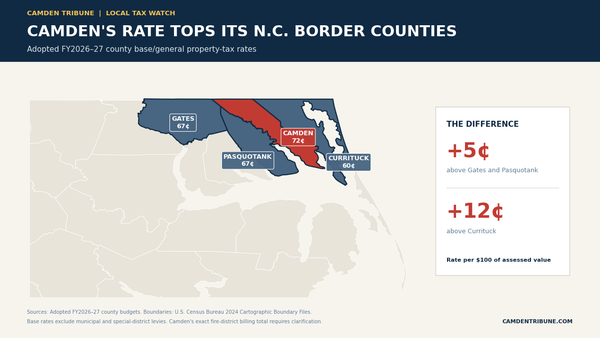
CAMDEN, N.C. — Camden County’s adopted property-tax rate remains higher than the countywide rates in each of its three direct North Carolina border counties, even after commissioners reduced the rate from the amount originally proposed.
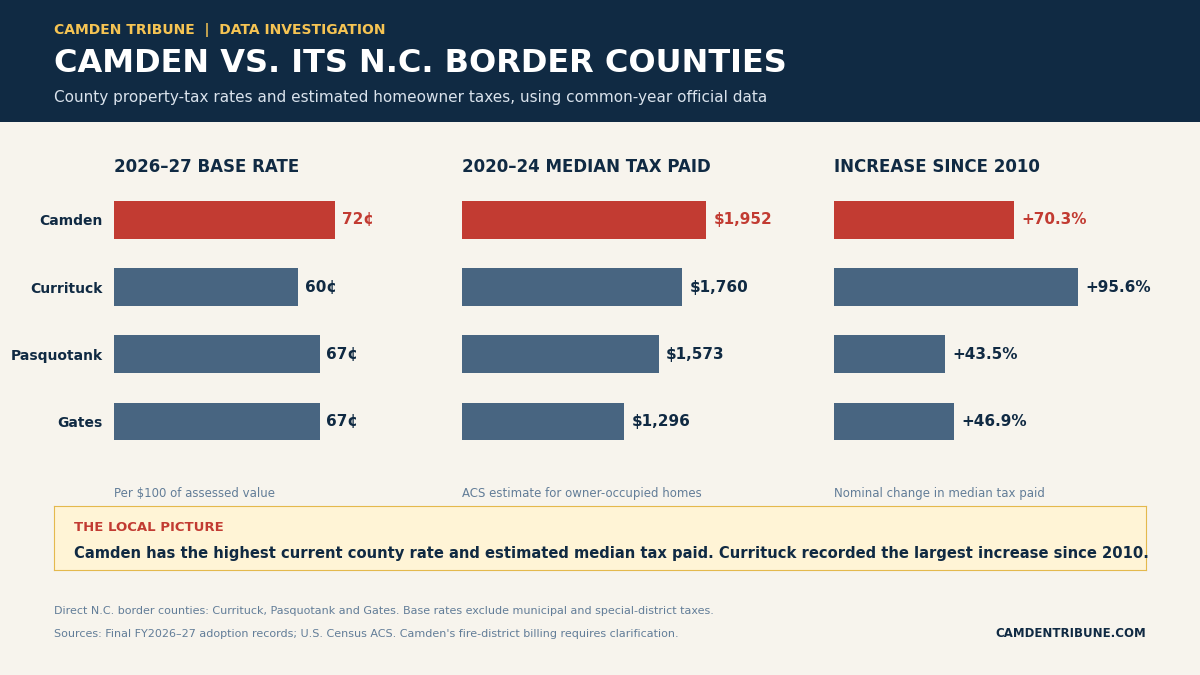
Camden commissioners adopted a countywide rate of 72 cents per $100 of assessed value on June 23. Gates and Pasquotank counties adopted 67 cents, while Currituck County’s official tax schedule lists 60 cents.
That places Camden 5 cents above Gates and Pasquotank and 12 cents above Currituck.
The comparison does not mean every Camden property receives the region’s highest total bill. Municipal taxes, fire districts, drainage districts, water and sewer districts, fixed fees, exemptions and assessed values can substantially change what an individual property carries.
But on the central countywide comparison, the final government records are clear: Camden has the highest base property-tax rate among its three N.C. border counties.
Quick Take
- Camden adopted a countywide rate of 72 cents per $100 of assessed value.
- Gates and Pasquotank adopted 67 cents; Currituck lists 60 cents.
- On a $300,000 assessment, Camden’s countywide tax calculation is $2,160.
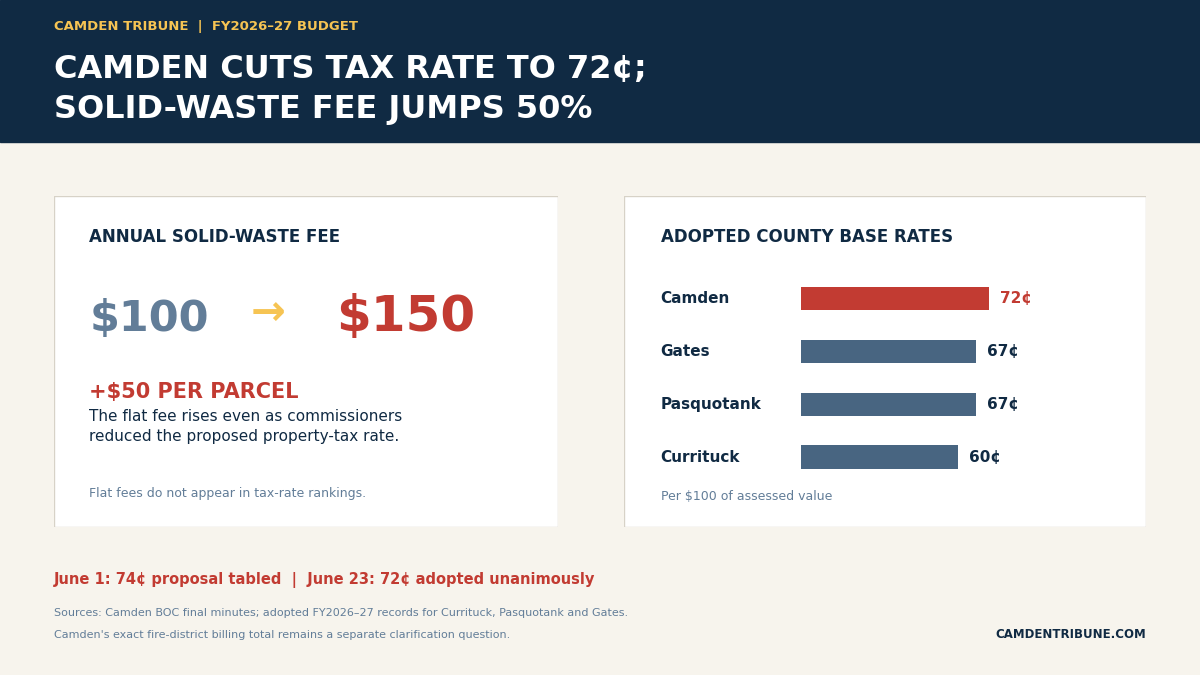
- Camden raised its annual solid-waste fee from $100 to $150 per parcel.
- The 74-cent figure in the June 1 packet was a proposal—not the final adopted rate.
- Properties inside either Camden fire district likely carry another one-cent district levy, but the county has not published a billing table confirming the combined rate.
How Camden Tribune verified the rates
Camden Tribune used final Board actions, adopted budget ordinances and current county tax-office schedules. Proposed budgets were used only to explain what changed before adoption.
Camden County — 72¢
June 23 final Board record
Currituck County — 60¢
Official county tax schedule
Pasquotank County — 67¢
June 15 adopted-budget minutes
Gates County — 67¢
Adopted FY 2026–27 budget ordinance
Camden’s adopted rate is 5¢ above Gates and Pasquotank and 12¢ above Currituck.
The final vote established 72 cents
The 74-cent figure appearing in Camden’s June 1 budget packet was a proposal, not the final adopted rate.
The June 1 meeting record shows that commissioners held the required budget hearing but tabled adoption after discussing whether the rate could be reduced to 72 or 71 cents.
At the June 23 special meeting, staff presented projections for rates of 74, 72 and 71 cents.
The final motion called for adoption of the remainder of the FY 2026–27 budget ordinance and Schedule of Fees “reflective of a tax rate of seventy-two cents (72 cents).” The motion passed.
Camden’s adopted FY 2026–27 countywide rate is 72 cents. The earlier 74-cent proposal was not enacted.
What the rates mean for an equal-value property
A property-tax rate is applied to each $100 of assessed value. Holding the assessment constant at $300,000 produces the following countywide calculations:
Camden County — 72¢
$2,160 on a $300,000 assessment
Gates County — 67¢
$2,010 on a $300,000 assessment
Pasquotank County — 67¢
$2,010 on a $300,000 assessment
Currituck County — 60¢
$1,800 on a $300,000 assessment
On that standardized assessment, Camden’s countywide calculation is $150 higher than Gates or Pasquotank and $360 higher than Currituck.
The Pasquotank County Board of Commissioners adopted its budget June 15 on a 4–3 vote. The resolution lists a 67-cent rate, an assessed valuation of approximately $4.75 billion and $31.6 million in ad valorem revenue.
Gates County’s adopted ordinance establishes a 67-cent rate. It lists an assessed valuation of approximately $1.44 billion and $9.64 million in property-tax revenue.
Currituck’s official tax schedule, updated July 1, lists a 60-cent countywide rate.
North Carolina does not impose a statewide real-property tax rate. Counties, municipalities and authorized special districts establish local property-tax rates.
Camden’s flat fee increased 50%
The property-tax rate is only part of Camden’s household-cost calculation.
The adopted Schedule of Fees raises the annual solid-waste fee from $100 to $150 per parcel. That is a $50 increase, or 50%.
Because solid waste is a flat charge, it does not rise or fall with assessed property value. It also does not appear in property-tax-rate rankings.
For a parcel assessed at $100,000, reducing the proposed rate from 74 to 72 cents lowers the tax calculation by $20. The $50 solid-waste increase is $30 greater than that reduction.
At $300,000, the two-cent rate reduction equals $60, while the solid-waste fee increases $50. That leaves a $10 difference before changes in assessed value, stormwater fees, exemptions or fire-district charges.
A typical residential stormwater fee is another $25, although Camden’s schedule varies by property category.
The county base rate is not always the final parcel rate
Currituck County has no incorporated municipalities, but it has several special tax districts.
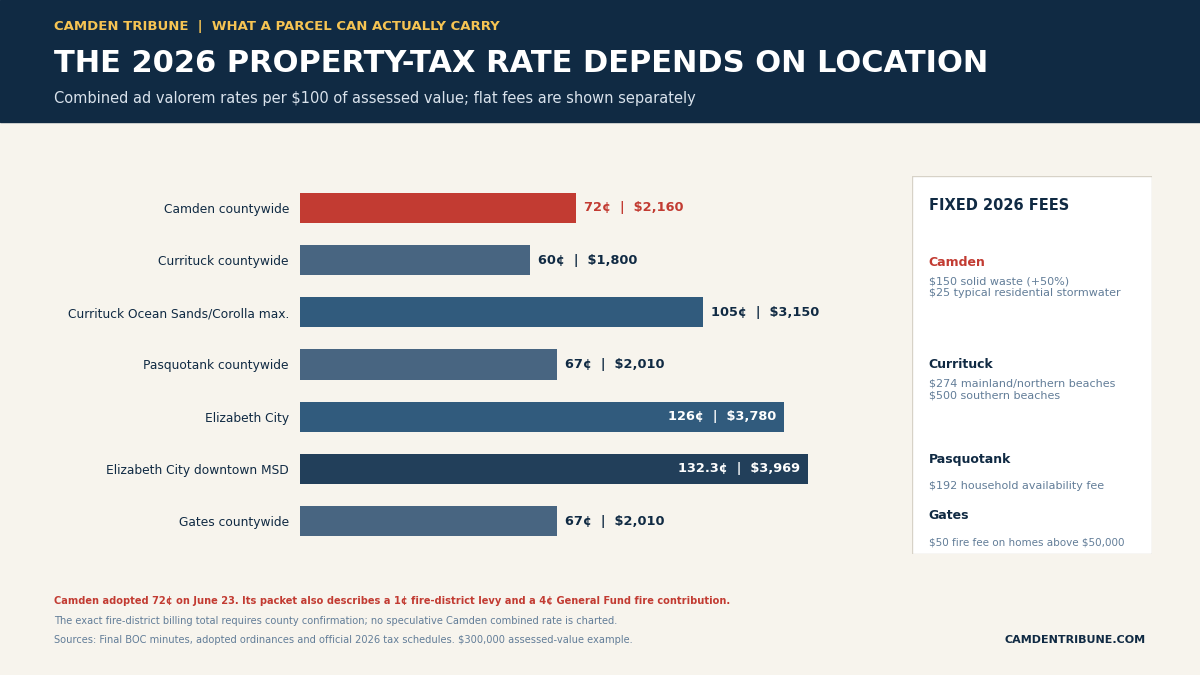
Currituck’s official schedule lists combined county and district rates ranging from 61 cents in the Moyock Watershed district to 105 cents for the listed combination of Ocean Sands stormwater, Ocean Sands water and sewer, and Corolla fire districts.
Currituck also lists annual solid-waste fees of $274 for mainland and northern-beaches dwellings and $500 for southern-beaches dwellings.
In Pasquotank County, property inside Elizabeth City carries both county and municipal taxes. Elizabeth City’s adopted FY 2026–27 ordinance establishes a 59-cent city rate.
Adding Pasquotank’s 67 cents produces a combined county and city rate of 126 cents. The Downtown Municipal Service District adds another 6.3 cents, producing a 132.3-cent total.
On a $300,000 assessment, those calculations are $3,780 inside Elizabeth City and $3,969 in the downtown service district.
Those examples demonstrate why Camden’s 72-cent figure should be described as the highest county base rate among the three border counties—not the region’s highest possible combined local rate.
The remaining Camden fire-district question
The June 23 vote settles the countywide rate at 72 cents. It does not fully explain how staff revised Article XIX of the proposed ordinance.
The packet describes a four-cent amount for the Courthouse-Shiloh and South Mills fire commissions and a separate one-cent levy inside each fire district. The two one-cent districts do not overlap; no parcel pays both district levies.
The fire narrative says residents’ five cents of fire funding consists of a one-cent fire tax and a four-cent “general fund contribution.” That wording indicates the four cents may be allocated from within the countywide General Fund rate rather than charged on top of it.
If that is how the Tax Department implemented the budget, property outside both fire districts carries 72 cents and property inside either district carries 73 cents.
However, Article XIX also uses the words “there is hereby levied” when describing the four-cent amount. The county has not published a rewritten Article XIX, final tax-code table or representative bill resolving that language.
Camden Tribune is reporting 72 cents as the adopted countywide rate. A 73-cent fire-district total appears likely, but it should not be presented as confirmed until the county provides its billing table or a sample FY 2026–27 bill.
The 74-cent proposal and a 79-cent literal addition should not be reported as Camden’s adopted FY 2026–27 rate.
Income affects how the same tax calculation lands
There are no completed full-year 2026 household-income statistics. The latest comparable official figures available in 2026 are the Census Bureau’s 2020–2024 American Community Survey five-year estimates, stated in 2024 dollars.
Camden County
Median household income: $91,078
$300,000 base tax: $2,160
Tax as share of median income: 2.37%
Currituck County
Median household income: $93,511
$300,000 base tax: $1,800
Tax as share of median income: 1.92%
Pasquotank County
Median household income: $66,589
$300,000 base tax: $2,010
Tax as share of median income: 3.02%
Gates County
Median household income: $66,333
$300,000 base tax: $2,010
Tax as share of median income: 3.03%
The calculation holds assessed value constant to illustrate burden. It does not claim that the typical household owns a $300,000 property.
The Census estimates also carry margins of error. Camden’s estimated median household income, for example, has a margin of error of approximately plus or minus $14,321.
Official Census profiles are available for Camden, Currituck, Pasquotank and Gates.
What the records establish
The official records support four principal conclusions:
- Camden adopted a 72-cent countywide property-tax rate.
- The 74-cent proposal was tabled and superseded.
- Camden’s adopted base rate remains higher than the countywide rates in all three of its N.C. border counties.
- The $150 solid-waste fee adds a separate household cost that does not appear in the property-tax-rate comparison.
The county still should provide a certified ordinance incorporating the 72-cent amendment and a tax-rate table showing the total applied inside each fire district.
Methodology: Camden Tribune reviewed Camden’s June 1 and June 23 meeting records, adopted neighboring-county records, official local tax schedules and Census ACS 2020–2024 estimates. Proposed budgets were used only to explain what changed before adoption. Standardized examples use a $300,000 assessed value unless otherwise stated. Fixed fees and unconfirmed Camden fire-district totals are shown separately.
Written by
Continue following this story
More Government Watch coverage
DEQ says no South Camden submission under review; Sawyer cited state staffing delays
DEQ says no related South Camden water or wastewater submission is currently under review and that additional county technical materials are expected. The response follows county statements citing state staffing delays.Sawyer Says South Mills Development Could ‘Outrun’ Sewer Plant as Moratorium Nears End
South Mills wastewater averaged about 25% of stated capacity in July, while Camden says proposed development will require substantially more treatment capacity.
Camden Board Backs Posting Delinquent Taxpayer Names on Social Media for ‘Extra Pressure’
Camden commissioners backed posting delinquent-tax information on county social media after the county manager said broader exposure could add “a little extra pressure” to pay.
Camden’s 30-Month Moratorium Nears End. DEQ Is Still Waiting on the Wastewater Model
Camden imposed a 30-month development moratorium to address water and sewer capacity. With four months left, DEQ says no wastewater permit application exists and it is still waiting on the completed model.
B&M schedules mining-permit meeting; Camden says no application is on file
B&M’s September 23 meeting concerns a proposed mining permit at 399 Ponderosa Drive. Camden says no application is on file; attendance questions remain.
Sawyer Says South Mills Development Could ‘Outrun’ Sewer Plant as Moratorium Nears End
South Mills wastewater averaged about 25% of stated capacity in July, while Camden says proposed development will require substantially more treatment capacity.
Camden Board Backs Posting Delinquent Taxpayer Names on Social Media for ‘Extra Pressure’
Camden commissioners backed posting delinquent-tax information on county social media after the county manager said broader exposure could add “a little extra pressure” to pay.