Pasquotank County to Launch Recovery Court in September
Pasquotank County will begin holding Recovery Court in September, combining treatment with judicial supervision for eligible residents involved in the criminal justice system.

This audio narration was generated by Camden Tribune using the open-source Kokoro speech model.
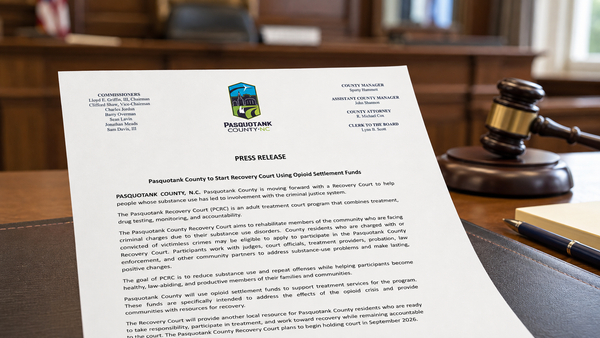
ELIZABETH CITY, N.C. — Pasquotank County plans to begin holding sessions of a new adult Recovery Court in September, creating a treatment-focused program for eligible residents whose substance-use disorders have contributed to their involvement with the criminal justice system.
Quick Take
- The Pasquotank County Recovery Court is expected to begin holding court in September 2026.
- The program will combine substance-use treatment with drug testing, monitoring and judicial supervision.
- Eligible participants will work with court officials, treatment providers, probation officers, law enforcement and community partners.
- Pasquotank County says opioid-settlement funds will support treatment services.
- The county has not disclosed the program’s cost, initial capacity or complete eligibility requirements.
How the program will work
The Pasquotank County Recovery Court, identified by the county as PCRC, will serve eligible adults whose substance-use disorders have contributed to criminal charges or convictions.
According to the county, participants will work with judges, court officials, treatment providers, probation officers, law-enforcement representatives and community organizations.
The program will combine treatment with drug testing, monitoring and court accountability. Its stated goals are to reduce substance use and repeat offenses while helping participants make sustainable changes in their lives.
The county plans to begin holding Recovery Court sessions in September, although it has not announced the first court date or location.
Why it matters
For eligible residents, Recovery Court could provide a treatment-focused path through the criminal justice system instead of relying exclusively on conventional prosecution, probation or incarceration.
The program could also affect participants’ families, public safety and the use of local court and treatment resources. Its results will depend on who qualifies, what services are available, how participants are supervised and what happens when someone completes—or does not complete—the program.
North Carolina’s Judicial Branch describes recovery courts as intensive, judicially supervised programs for people involved in the court system who are navigating substance-use disorders, mental-health conditions or both.
Such programs generally use individualized treatment plans, testing, frequent court supervision, incentives and sanctions. The broader goals include reducing substance dependence and repeat offenses while improving coordination among courts, treatment providers and community organizations.
Who could qualify?
Pasquotank County said residents charged with or convicted of what it described as “victimless crimes” may be eligible to apply.
The announcement did not define that term or identify the charges that would qualify or disqualify an applicant. It also did not explain whether participation will be available before conviction, after conviction or at both stages.
Other unanswered questions include who may refer an applicant, who will make the final eligibility decision and what will happen to the underlying criminal charge when someone completes the program.
Settlement funds will support treatment
Pasquotank County says opioid-settlement funds will support treatment services for Recovery Court participants.
Those funds originate from national legal settlements involving companies accused of contributing to the opioid crisis. Under North Carolina’s settlement framework, the money must be used for approved strategies addressing opioid misuse, addiction, overdose and recovery.
The county’s announcement did not disclose how much settlement funding will be used for the Recovery Court or how long that funding is expected to support the program.
Details still to be announced
In addition to the funding amount and complete eligibility rules, Pasquotank County has not publicly identified:
- The judge or judges who will preside;
- The treatment providers that will participate;
- The number of people the program can initially serve;
- The expected length of participation;
- Whether participants will be responsible for any fees;
- The incentives or sanctions that may be used; or
- How completion, repeat offenses and other program outcomes will be measured and reported.
Those details will help residents understand who will receive the opportunity, how public settlement funds will be used and whether the program produces measurable results.
References
- Pasquotank County, “Pasquotank County to Start Recovery Court Using Opioid Settlement Funds,” released Aug. 13, 2026.
- North Carolina Judicial Branch: Recovery Courts.
- North Carolina Opioid Settlements.
Reporting location: Camden County and Elizabeth City, North Carolina. This report is based on Pasquotank County’s official announcement and information published by the North Carolina Judicial Branch and North Carolina Opioid Settlements.
Written by
Continue following this story
More Pasquotank County coverage
Pasquotank Commissioners' Schedule Aug. 17 Capital Projects Work Session
Pasquotank commissioners will meet Aug. 17 to discuss five county facility projects, including courthouse repairs and a Newland public-safety substation.
B&M schedules mining-permit meeting; Camden says no application is on file
B&M’s September 23 meeting concerns a proposed mining permit at 399 Ponderosa Drive. Camden says no application is on file; attendance questions remain.
Sawyer Says South Mills Development Could ‘Outrun’ Sewer Plant as Moratorium Nears End
South Mills wastewater averaged about 25% of stated capacity in July, while Camden says proposed development will require substantially more treatment capacity.
Camden Board Backs Posting Delinquent Taxpayer Names on Social Media for ‘Extra Pressure’
Camden commissioners backed posting delinquent-tax information on county social media after the county manager said broader exposure could add “a little extra pressure” to pay.